Encourage Strong Rooting
Plant young trees slightly deeper than the nursery soil line, ensuring the root flare is still visible, to anchor them well and reduce wind rock in exposed sites.

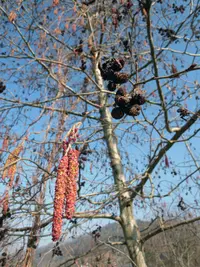
Grey alder, Alnus incana, is a fast-growing deciduous tree in the birch family, typically found along rivers, lakeshores, and moist slopes. It forms a narrow, upright crown with smooth gray bark and matte, oval leaves that give it a clean, light appearance in the landscape.
This species is native to northern and central Europe, parts of Asia, and North America, where it often colonizes poor or disturbed soils. As a nitrogen-fixing plant, it can improve soil fertility, which makes it relatively undemanding once established and helps explain how to care for Grey Alder in low-quality ground.
Grey alder generally prefers full sun, consistent moisture, and cool to moderate climates, and it tolerates wet or gravelly soils better than many other trees.

Care Difficulty
Easy Care

Light Preference
Full Sun

Water Requirements
Keep Soil Moist

Temperature Preference
Cold Hardy

Hardiness Zone
2–6

Soil Texture
Sandy, Loamy, Clay

Soil pH
Acidic (5.5–6.5), Slightly acidic (6.5–7.0)

Soil Drainage
Waterlogged tolerant

Fertilization
Minimal (feed rarely)
Scan your plant to receive care tips personalized for your specific plant
Available on iOS and Android
Alnus incana prefers full sun in cool climates and light shade in hotter regions.
Alnus incana is adapted to moist sites but still benefits from controlled watering.
This hardy tree tolerates cold climates but grows best within a moderate temperature range.
Humidity is rarely a limiting factor for Alnus incana, which adapts to a wide humidity range outdoors, so targeted humidity management is usually unnecessary for Grey Alder in typical garden conditions.
Alnus incana prefers moist, deep, and well-aerated soils but tolerates a range of textures if drainage is adequate.
This species is generally unsuited to long-term container growing due to its vigorous root system and eventual size.
This nitrogen-fixing tree usually needs minimal feeding but responds to light fertilization on poor soils.
Alnus incana benefits from light structural pruning to maintain a stable, healthy crown.
This species is typically grown in the ground, so focus on careful transplanting rather than frequent repotting.
Alnus incana is most commonly propagated from seed, with some use of hardwood cuttings in managed settings.
This cold-hardy species generally needs little winter care when planted in the ground in suitable climates.

Plant Health Check
Not sure what's wrong with your plant? Check your plant's health inside the app.
Alnus incana forms root nodules with Frankia actinomycete bacteria, allowing it to fix atmospheric nitrogen and enrich poor, disturbed soils where other woody plants struggle to establish.
This species naturally colonizes gravel bars, riverbanks, and landslide areas in cool-temperate and boreal regions, stabilizing substrates and preparing the site for later forest succession.
Alnus incana is divided into several recognized subspecies native to Europe, Asia, and North America, each adapted to local climates and hydrology while sharing similar ecological functions.

Archaeological wood analyses show that speckled alder (Alnus incana) was historically used in northern and central Europe for items exposed to water, such as stakes and small constructions in wetlands, because its wood remains comparatively durable and dimensionally stable when kept continuously waterlogged.
This species is typically fast-growing, often adding 30–60 cm of height per year in suitable conditions. Growth is quickest on moist, fertile, well-drained soils and slows noticeably on dry, compacted, or very poor sites.
Keep your plants happy and healthy with plant identification, disease detection, and easy care guidance.