Windfirm training
In the first 2–3 years, stake young trees on the windward side and gradually loosen ties each season so the trunk flexes slightly and develops stronger taper and anchorage.

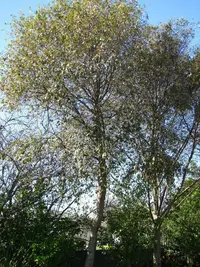
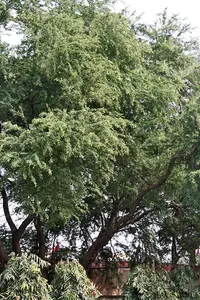
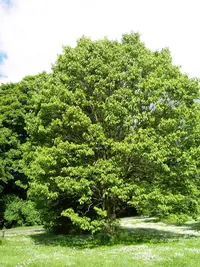
Mexican alder, Alnus jorullensis, is a fast-growing deciduous tree valued for its narrow, upright form and smooth gray bark. It often keeps foliage longer in mild climates, giving a semi-evergreen look. Native to the highlands of Mexico and Central America, it commonly grows along streams and on moist mountain slopes. The tree fixes nitrogen in the soil, which supports relatively quick growth and good vigor in suitable conditions. It generally prefers full sun, consistent moisture, and well-drained, slightly acidic to neutral soil. These traits make it fairly straightforward to care for Mexican alder in cool to mild climates with adequate water.

Care Difficulty
Moderate Care

Light Preference
Full Sun

Water Requirements
Regular Water

Temperature Preference
Warm Climate

Hardiness Zone
8–10

Soil Texture
Loamy, Clay, Organic-rich

Soil pH
Acidic (5.5–6.5), Slightly acidic (6.5–7.0)

Soil Drainage
Moist but well-drained

Fertilization
Minimal (feed rarely)
Scan your plant to receive care tips personalized for your specific plant
Available on iOS and Android
Alnus jorullensis grows best with strong light typical of open, cool to mild climates.
Alnus jorullensis prefers consistently moist soil but not standing water.
This highland alder thrives in mild climates with cool to moderate temperatures.
This species tolerates a wide humidity range and rarely needs special humidity management outdoors.
Soil for Alnus jorullensis should be moist, well-structured, and not compacted.
This fast-growing tree is generally unsuitable for long-term container culture, except for short-term use in large, heavy tubs outdoors.
Alnus jorullensis usually needs minimal fertilization because it fixes atmospheric nitrogen through root nodules.
Alnus jorullensis benefits from light, structured pruning to maintain a stable crown and safe framework.
This alder is usually grown as a landscape tree, so transplanting young stock correctly is more important than long-term container culture.
Alnus jorullensis is most commonly propagated from seed, with some use of hardwood cuttings in professional settings.
Established Alnus jorullensis trees are generally cold hardy in mild to cool climates and need limited winter care.

Plant Health Check
Not sure what's wrong with your plant? Check your plant's health inside the app.
This species is naturally distributed in high-altitude cloud forests of Mexico and Central America, often between roughly 2,000–3,500 m where cool temperatures and frequent mists dominate.
Like other true alders, it forms symbioses with Frankia bacteria in its root nodules, which convert atmospheric nitrogen into plant-available forms and enrich surrounding soils in montane forests.
Unlike many temperate alders that are deciduous, this species is functionally evergreen or very briefly deciduous in mild climates, maintaining foliage for most of the year in its cool, moist native range.

Alnus jorullensis is widely used as a fast-growing nurse tree in highland reforestation and erosion-control projects in Mexico and parts of South America because it quickly stabilizes slopes, tolerates poor soils, and improves fertility through biological nitrogen fixation.
Yellowing leaves often result from waterlogged soil, compacted roots, or nutrient-poor ground, especially low nitrogen. Improve drainage, avoid standing water, and apply a balanced, slow-release fertilizer. Check for root damage after storms or construction work nearby.
Keep your plants happy and healthy with plant identification, disease detection, and easy care guidance.