Elevated pot placement
Place containers on pot feet or a wire mesh shelf so water drains quickly away from the base and air circulates under the pot, which greatly reduces the risk of root and crown rot in this species.

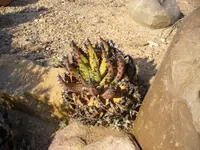
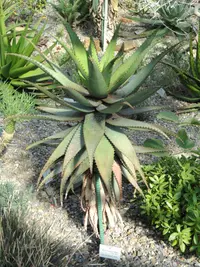
Black-thorn aloe, Aloe melanacantha, is a compact, slow-growing succulent from the arid regions of South Africa and Namibia. It forms tight rosettes with thick, triangular leaves. The leaves are blue-green to gray-green and armed with very hard, dark spines along the edges and tip, giving the plant a strong, armored look. Mature plants may produce a tall flower stalk with tubular orange to red blooms. This species is drought-tolerant and prefers bright light, fast-draining sandy soil, and careful watering that avoids prolonged wetness around the roots. These traits make it durable but less forgiving of overwatering, so learning how to care for black-thorn aloe is important for long-term success.

Care Difficulty
Moderate Care

Light Preference
Full Sun

Water Requirements
Low Water

Temperature Preference
Warm Climate

Hardiness Zone
9–11

Soil Texture
Sandy, Loamy, Rocky

Soil pH
Slightly acidic (6.5–7.0), Neutral (7.0)

Soil Drainage
Well-drained

Fertilization
Minimal (feed rarely)
Scan your plant to receive care tips personalized for your specific plant
Available on iOS and Android
This sun-loving succulent thrives in bright, open positions with strong light and good air movement.
Watering should mimic arid habitats, with thorough soaking followed by a clear dry period.
This species prefers warm, dry conditions and tolerates notable heat when well established.
This arid-adapted species tolerates typical indoor humidity and rarely needs special adjustments.
This species needs a very fast-draining, mineral-heavy substrate to avoid root and crown rot.
This compact, slow-growing succulent is well suited to container culture.
This slow-growing desert succulent needs only light feeding to stay healthy in containers.
Aloe melanacantha needs minimal pruning, mainly for hygiene and safety rather than shaping.
This aloe grows slowly and prefers staying slightly root-bound, so repotting is infrequent.
Propagation of Aloe melanacantha is possible but slower than many common aloes.
This species prefers mild, dry winters and has limited frost tolerance, especially in containers.

Plant Health Check
Not sure what's wrong with your plant? Check your plant's health inside the app.
The leaf spines of this species start out reddish in strong light and gradually age to a hard, glossy black, which is the origin of the name melanacantha, meaning black-spined.
This aloe is naturally restricted to the arid western parts of South Africa and southern Namibia, where it grows on rocky slopes and gravelly flats in winter-rainfall succulent Karoo vegetation.
Plants form very compact, almost spherical rosettes with stiff, thick leaves so heavily armed with marginal and terminal spines that they create an effective barrier against grazing animals.

In extremely harsh, exposed sites, this species often grows partly sunken among stones, using the surrounding rocks to buffer temperature and reduce water loss, a microhabitat strategy typical of plants highly adapted to desert-edge conditions.
Lack of flowers usually comes from insufficient light, plants that are still immature, or irregular dry cool winters. Outdoor plants in bright, hot, arid conditions bloom more reliably than shaded or constantly watered specimens.
Keep your plants happy and healthy with plant identification, disease detection, and easy care guidance.