


Rejuvenation trimming
Every 1–2 years, lightly trim back the longest, bare trailing stems in early spring to encourage denser new growth at the crown and prevent the plant from becoming thin and woody.

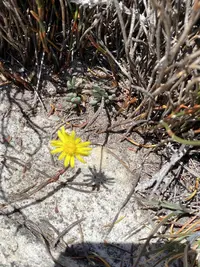
Little pickles, Crassothonna capensis, is a trailing succulent from South Africa, valued for its small, elongated, bead-like leaves and slender cascading stems. It is often used in hanging baskets, mixed succulent containers, or as a small-scale groundcover in warm climates.
This plant stores water in its leaves, which makes it relatively forgiving of short dry spells and suitable for beginners learning how to care for Little Pickles. Growth is fastest in bright light with some direct sun, in airy, well-drained soil that prevents excess moisture around the roots.
In suitable conditions it forms soft, trailing mats and may produce small, daisy-like yellow flowers that attract pollinators outdoors.

Care Difficulty
Easy Care

Light Preference
Full Sun

Water Requirements
Low Water

Temperature Preference
Warm Climate

Hardiness Zone
9–11

Soil Texture
Sandy, Loamy, Rocky

Soil pH
Slightly acidic (6.5–7.0), Neutral (7.0)

Soil Drainage
Well-drained

Fertilization
Minimal (feed rarely)
Scan your plant to receive care tips personalized for your specific plant
Available on iOS and Android
This trailing succulent prefers bright light with some protection from intense midday sun.
Watering for this succulent should favor dry spells over constant moisture.
This plant prefers mild, frost-free conditions with warm days and cooler nights.
This trailing succulent handles typical indoor humidity without special measures.
Crassothonna capensis prefers a very fast-draining, mineral-rich substrate that dries quickly between waterings.
This species is well suited to container culture, especially hanging baskets and shallow bowls.
Crassothonna capensis grows best with light feeding during its active season, as a supplement to strong light and proper watering.
Pruning Crassothonna capensis helps maintain a compact, trailing form and supports healthy growth.
Crassothonna capensis has a shallow root system and prefers slightly tight pots, so repotting is infrequent.
Crassothonna capensis is commonly propagated from stem cuttings, which root well in warm, bright conditions.
This succulent dislikes prolonged freezing and needs basic winter protection in cold climates.

Plant Health Check
Not sure what's wrong with your plant? Check your plant's health inside the app.
This species was long known as Othonna capensis until molecular studies of the daisy family (Asteraceae) supported placing it in the genus Crassothonna, so many older books and labels still use the former name.
Although it looks like many leaf-succulents, this plant is actually in the daisy family and produces small, yellow, composite flower heads similar in structure to miniature daisies.
In its native range in South Africa, this species often grows trailing over rocks and from crevices, where well-drained, gritty substrates and strong light favor its dense, bead-like foliage.

In cultivation, selected forms of this species such as the popular purple-leaved clone ‘Ruby Necklace’ are thought to be horticultural selections of Crassothonna capensis rather than separate species, showing how much leaf color and stem tone can vary within a single genetic lineage.
Leggy, stretched stems usually mean light is too low or coming from one direction. Rotate the pot regularly and move it to a brighter position. Pinch or lightly trim long stems to encourage branching and denser growth.
Keep your plants happy and healthy with plant identification, disease detection, and easy care guidance.

-1-200x150.webp)