Provide climbing support
Mount the plant on cork bark or tree fern and secure new pseudobulbs and roots loosely with soft ties or fishing line so the stems can climb and root firmly instead of hanging and breaking.

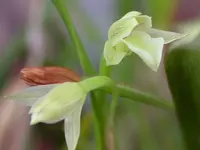
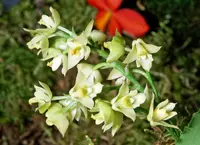
Scaphyglottis prolifera is an epiphytic orchid that forms climbing or scrambling stems with many small, closely spaced pseudobulbs and narrow leaves. It often creates dense, layered clumps along tree trunks and branches.
This species is native to humid tropical forests of Central and South America, where it grows in bright, filtered light and high air humidity. Flowers are typically small and not grown for showy display, but the plant is valued for its interesting growth habit and ability to form living columns of foliage.
It suits experienced growers or patient beginners who want to learn how to care for Scaphyglottis prolifera, especially in warm, stable indoor or greenhouse conditions with good air movement and even moisture.

Care Difficulty
Hard Care

Light Preference
Partial Shade

Water Requirements
Keep Soil Moist

Temperature Preference
Tropical / Frost Sensitive

Hardiness Zone
Unknown

Soil Texture
Peaty, Organic-rich

Soil pH
Acidic (5.5–6.5)

Soil Drainage
Moist but well-drained

Fertilization
Light (every 4–6 weeks)
Scan your plant to receive care tips personalized for your specific plant
Available on iOS and Android
This orchid prefers bright, indirect light that mimics dappled forest canopy conditions.
This species prefers consistently moist but never waterlogged conditions around its roots.
Stable warm conditions are important for healthy growth and flowering.
This epiphytic orchid prefers consistently moist air and reacts quickly to very dry conditions.
In cultivation this species performs best in a very loose, airy, bark-based medium rather than dense mineral soil.
This orchid adapts well to container culture when the pot and support are chosen for its climbing, spreading habit.
This orchid benefits from light, targeted feeding during active growth but is sensitive to excess salts.
Pruning needs are minimal and mainly focus on hygiene and maintaining a compact clump.
Container‑grown plants appreciate fresh medium from time to time to keep roots healthy and aerated.
Propagation is usually done by division, using established clumps with multiple healthy canes.
This orchid is frost sensitive and needs protection from low temperatures in most climates.

Plant Health Check
Not sure what's wrong with your plant? Check your plant's health inside the app.
This orchid produces elongated, often climbing chains of pseudobulbs that arise successively from the tips of older ones, creating a characteristic proliferating growth pattern that inspired its species name prolifera.
It is native to tropical America from lowland rainforests up into montane cloud forests, and has been recorded at elevations from near sea level to around 1,800 m, showing notable tolerance of different temperature and moisture regimes.
Flowers are small, pale, and relatively short-lived, and are thought to be pollinated mainly by small bees that can navigate the tight floral structures typical of many Scaphyglottis species.
This orchid usually flowers in warm months, often late spring to early autumn, depending on climate. It produces small, pale, tubular flowers along the stems. Individual blooms are modest but can appear repeatedly on successive growths.
Keep your plants happy and healthy with plant identification, disease detection, and easy care guidance.