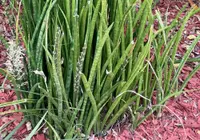
tree aloe Care (Aloidendron barberae)

Also known as: Eastern Tree Aloe
tree aloe

About tree aloe

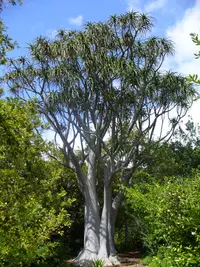
Tree aloe (Aloidendron barberae) is a large, trunk-forming succulent tree from South Africa and Mozambique. It develops a thick gray trunk with branching, candelabra-like arms and rosettes of long, arching, slightly recurved leaves at the tips. In the landscape it becomes a striking architectural specimen; in containers it stays much smaller but still slowly gains a tree-like form. This species is drought tolerant and generally tough, but it needs very bright light, excellent drainage, and protection from hard frost. Once those basics are met, it is relatively straightforward to care for tree aloe.

Main Plant Requirements

Care Difficulty

Moderate Care

Light Preference

Full Sun

Water Requirements

Low Water

Temperature Preference

Tropical / Frost Sensitive

Hardiness Zone

10–11

Soil Texture

Sandy, Loamy, Rocky

Soil pH

Slightly acidic (6.5–7.0), Neutral (7.0)

Soil Drainage

Well-drained

Fertilization

Minimal (feed rarely)

Get Personalized Care Plan

Scan your plant to receive care tips personalized for your specific plant

Available on iOS and Android

How to Care for the tree aloe

This large succulent tree thrives in bright, warm conditions with strong but not extreme sun exposure.

  • Provide 6–8 hours of sun daily; full morning sun with light afternoon shade suits tree aloe in most climates.
  • In hot, inland areas, protect from harsh sun between 11 am–3 pm to reduce leaf scorch and pale, sunburned patches.
  • In coastal or mild regions, it tolerates more direct sun; in deeper shade, expect slower growth, lanky stems, and sparse canopy.

This drought-tolerant species prefers deep, infrequent watering and very free-draining soil.

  • Allow the top 5–8 cm of soil to dry fully before watering; in hot, dry periods this may mean soaking every 2–4 weeks outdoors.
  • In winter or cool, overcast spells, reduce watering sharply; only water when soil is dry and no rain is forecast for several days.
  • Use sharply draining, sandy or gravelly soil; soft, yellowing leaves, stem rot, or a sour smell signal overwatering, while wrinkled, folding leaves indicate thirst.

This species prefers warm, dry climates and does best when protected from frost and prolonged cold.

  • Ideal growth occurs around 65–85°F (18–29°C), with warm, bright conditions and good air movement.
  • Short dips to about 28–30°F (-2 to -1°C) may be survived by mature plants, but repeated frosts damage leaves and young tips.
  • In areas above 95°F (35°C), provide some afternoon shade and avoid reflected heat from walls; shelter from cold, drying winds in winter.

Humidity is rarely a limiting factor for this species in homes or dry outdoor climates.

  • Ideal humidity is 30–50%, matching most heated or air-conditioned indoor air.
  • Tree aloe tolerates very dry air; leaf problems usually come from overwatering, not low humidity.
  • If tips shrivel while soil stays dry, slightly raise humidity with nearby plants or a pebble tray rather than misting.

This species needs mineral, sharply draining soil to prevent root and stem rot.

  • Use a gritty, sandy mix such as 50–70% inorganic material (coarse sand, pumice, perlite) with the rest a lean cactus potting mix.
  • Target a slightly acidic to neutral pH of about 6.0–7.0, avoiding strongly acidic or alkaline substrates that limit nutrient uptake.
  • Ensure rapid drainage; water should exit the pot within seconds, with no pooling or persistent wet patches in the mix.
  • For landscape planting, amend heavy clay with large volumes of coarse grit or crushed gravel to increase aeration and prevent waterlogging for Aloidendron barberae.

This species can be grown in containers, especially in cooler climates where winter protection is needed.

  • Choose a wide, heavy container to counter the tall, top-heavy canopy and reduce tipping risk in wind.
  • Select unglazed clay or concrete pots to allow moisture to evaporate faster and keep roots from staying wet for long periods.
  • Raise the pot slightly on feet or bricks so drainage holes stay clear and excess water exits quickly after irrigation or rainfall.

Aloidendron barberae benefits from light, controlled feeding during the warm growing season.

  • Use a balanced liquid fertilizer (around 10-10-10 or 20-20-20) diluted to 25–50% strength for container plants.
  • Feed every 4–6 weeks in spring and summer; skip feeding for in-ground specimens in fertile, well-drained soil.
  • Stop fertilizing in fall and winter when growth slows to avoid weak, elongated tissues.
  • Compost or a low-dose slow-release fertilizer can be mixed into the topsoil once per year for sustained nutrition.

Pruning is mainly used to control size and remove weak growth on Aloidendron barberae.

  • Carry out structural pruning in late winter or early spring before strong new growth starts.
  • Remove dead, damaged, crossing, or congested branches with clean, sharp loppers or a pruning saw.
  • Shorten or remove selected stems to manage height and canopy spread, creating a stable, well-balanced crown.
  • Allow large cuts to dry and callus; avoid heavy pruning in very hot or wet periods to reduce stress and rot risk.

Container-grown or young landscape plants of this species need infrequent but careful transplanting.

  • Look for roots circling the pot, pushing through drainage holes, or noticeably slowed growth as signals to move Aloidendron barberae.
  • Plan repotting or transplanting for late spring to early summer, when soil is warm and recovery is fastest.
  • Repot large containers every 3–5 years into a slightly bigger pot with coarse, sharply draining cactus or succulent mix.
  • Handle the root ball gently, keep roots shaded, water once after planting, then allow the soil to dry partly to limit stress and rot.

Propagation of Aloidendron barberae is possible but slower and usually done by advanced growers.

  • Use semi-woody stem cuttings taken in late spring or early summer for the most reliable method.
  • Allow cut ends to dry and callus for several days, then plant in a gritty, barely moist succulent mix.
  • Provide bright, indirect light, warm temperatures around 70–80°F, and very light watering until roots form.
  • Seed propagation is possible under warm, bright conditions, but germination and early growth are slow and require patience.

This species is frost sensitive and needs thoughtful winter care in cooler climates.

  • Aim to keep temperatures above 30°F; even light frost can scar leaves and young tips.
  • In-ground plants benefit from a dry, coarse mulch around the root zone, kept away from the trunk base.
  • Move container-grown specimens indoors or to a bright, sheltered spot before freezing nights arrive.
  • Water sparingly in winter, allowing soil to dry well between waterings to minimize cold-related root rot risks.

Care Tips

Manage Top-Heavy Growth

Stake young plants with a sturdy post on the windward side and use soft, wide ties so the trunk can thicken gradually without snapping in storms as the crown becomes heavier.

Encourage Strong Trunk

Plant slightly deeper than the original nursery soil line and avoid frequent small waterings so roots grow down and out, creating a stable base that supports the eventual tree-like canopy.

Plan Branch Structure

In the first 3–5 years, selectively remove weak or crossing branches and keep 3–5 well-spaced main limbs so the mature canopy remains balanced and less prone to storm damage.

Protect From Frost Pockets

Site the plant on a slight mound or higher ground away from low-lying frost pockets, and in borderline climates wrap the trunk with breathable frost cloth during rare cold snaps.

Surface Root Management

In landscapes, keep a 60–90 cm grass-free mulch ring around the base to reduce root competition and avoid planting close to walls, paving, or pools where expanding surface roots may cause lifting over time when growing tree aloe.

Common Pests and Diseases

Aloe mite

This pest causes abnormal, swollen, or coral-like growths on stems and leaf bases known as aloe cancer galls. Symptoms include distorted tissue that may be pink, green, or brown and gradually disfigures branching points on tree aloe.

Solution

Prune out all affected tissue well below the galled area with clean, sterilized tools and dispose of it in the trash, not compost. After removal, monitor new growth closely, maintain good airflow, and in landscape situations consider a targeted miticide labeled for eriophyid mites if fresh galls continue to appear.

Aloe scale

These insects appear as small, hard, brown or gray bumps clustered on stems and along leaf bases, often on older wood. This pest feeds on sap, leading to yellowing, reduced vigor, and sticky honeydew that can attract sooty mold.

Solution

Physically remove scale by gently scraping with a soft brush or cloth, then wipe stems with a cotton pad lightly moistened with isopropyl alcohol. For larger outdoor specimens, apply a horticultural oil spray during mild weather to smother remaining scale, repeating as needed according to label directions.

Aloe rust

This disease produces yellow spots on the leaf surface that turn brown, with dark orange to black spore pustules on the underside. Symptoms include localized leaf spotting rather than soft rot, and heavily affected leaves may yellow and dry early.

Solution

Remove and discard infected leaves promptly and avoid wetting the foliage when watering. Improve spacing and airflow around the plant, and in humid outdoor climates use a sulfur or copper-based fungicide labeled for rust on ornamentals if spotting continues to spread.

Aloe leaf spot

This disease causes irregular dark brown to black spots on leaves, sometimes with a pale halo, often starting on older or lower foliage. Symptoms include scattered lesions that can coalesce, giving leaves a blotchy, stressed appearance, especially after prolonged humidity or overhead watering.

Solution

Cut off the most damaged leaves and discard them, then water at the base to keep foliage dry. Provide strong light, good airflow, and for landscape specimens in chronically humid areas consider applying a broad-spectrum ornamental fungicide at the first sign of new spotting.

Mealybugs

These insects form white, cottony clusters in leaf axils, around roots near the soil line, and on sheltered stem crevices. This pest sucks sap, causing stunted growth, slight wilting, and sticky honeydew, and is a common problem in tree aloe indoor care, especially in low airflow conditions.

Solution

Dab visible mealybugs with a cotton swab dipped in isopropyl alcohol and rinse the plant gently to remove residues. For recurring infestations, repeat spot treatments weekly and, for larger outdoor plants, consider a low-toxicity systemic insecticide labeled for ornamentals while also reducing excess nitrogen fertilization that encourages soft, mealybug-prone growth.

Interesting Facts

Largest tree aloe

This species is the tallest of all tree aloes, forming a real tree with a single trunk that can reach over 15 m in its native range of South Africa and Mozambique.

Bird-pollinated blooms

Its tubular, salmon-pink to orange flowers are rich in nectar and are primarily pollinated by sunbirds, which visit the tall flowering clusters high above the ground.

Hybridization with Aloidendron dichotomum

In cultivation it readily hybridizes with Aloidendron dichotomum, producing the well-known hybrid Aloidendron 'Hercules', which combines traits of both parent species and is widely used in dry landscapes.

Botan icon

Did you know?

Fossil and paleobotanical evidence indicate that this species is a relict of once more widespread tree aloe lineages in southern Africa, surviving today in scattered pockets of frost-free coastal and riverine habitats where conditions remained suitable over long geological periods.

FAQs about tree aloe

Growth is moderate for a succulent tree. Young plants typically add 15–30 cm in height per year under warm, bright, stable conditions. It usually needs at least 5–7 years to begin forming a noticeable trunk.

Grow Healthy Plants with Botan Care

Keep your plants happy and healthy with plant identification, disease detection, and easy care guidance.

Botan plant care app — identify plants on mobile

Explore More Plants