Prevent Stem Rot
When planting or repotting, sit the plant on a shallow mound of gritty soil so the root collar and lower stem remain slightly elevated and dry faster after rare deep waterings, which greatly reduces stem and crown rot risk.

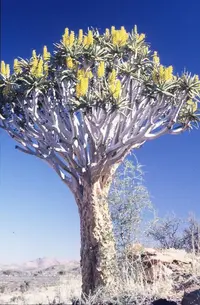
The quiver tree, Aloidendron dichotomum, is a large, tree-forming succulent from arid regions of South Africa and Namibia. It belongs to the aloe family but develops a tall, branching trunk. Mature plants show a striking silhouette with a rough, corky bark and a rounded crown of rigid, blue-green leaves. In habitat, it endures intense sun, heat, and drought. This background makes it slow-growing but long-lived when its basic needs are met. Its toughness appeals to collectors, but its size and sensitivity to excess moisture make it more suitable for experienced growers. A well-lit, very well-drained, and dry environment is essential to care for Quiver Tree successfully.

Care Difficulty
Moderate Care

Light Preference
Full Sun

Water Requirements
Low Water

Temperature Preference
Warm Climate

Hardiness Zone
9–11

Soil Texture
Sandy, Loamy, Rocky

Soil pH
Slightly acidic (6.5–7.0), Neutral (7.0)

Soil Drainage
Well-drained

Fertilization
Minimal (feed rarely)
Scan your plant to receive care tips personalized for your specific plant
Available on iOS and Android
This desert succulent needs strong light and benefits from long hours of direct sun once established.
This species is highly drought-tolerant and prefers deep but infrequent watering.
This arid-climate tree thrives in hot, dry conditions and dislikes prolonged cold or excess humidity.
This desert succulent tolerates very low humidity and usually needs no special humidity management.
This species needs very fast-draining, mineral-rich soil to prevent root and stem rot.
This slow-growing tree aloe can be maintained in containers for many years when provided with very sharp drainage and strong stability.
This desert tree needs minimal feeding, but light, careful fertilization supports container-grown or young Quiver Tree specimens.
Pruning Aloidendron dichotomum is usually light and focused on safety and health rather than shaping.
Transplanting this slow-growing desert tree is infrequent and should be done carefully to limit root disturbance.
Propagation of Aloidendron dichotomum is possible but slow and more common from seed than from cuttings.
This species tolerates cool, dry winters but is sensitive to prolonged hard freezes, especially in containers.

Plant Health Check
Not sure what's wrong with your plant? Check your plant's health inside the app.
This species stores water not only in its leaves and trunk but also in a spongy, fibrous wood that helps it survive in extremely arid desert conditions with minimal rainfall.
The pale, powdery bloom on its bark and leaves reflects intense sunlight, reducing heat load on the tissues and protecting the plant from overheating in high-radiation habitats.
Its densely branched crown provides important nesting and roosting sites for birds in the Namib and Karoo regions, offering shade and elevated protection in otherwise sparse landscapes.

The branching pattern of this species often follows a regular, forked architecture that has been used in ecological and mathematical studies as a real-life example of fractal-like tree growth in extreme environments.
This species grows very slowly, usually adding only a few cm in height per year. Seedlings stay small for many years, and even in ideal conditions it can take decades to form a noticeable trunk.
Keep your plants happy and healthy with plant identification, disease detection, and easy care guidance.