Rock mulch ring
Create a 10–20 cm wide ring of coarse stones or gravel around the base to keep the root zone dry at the surface, reduce soil splash on the stem, and stabilize the plant in windy, arid sites.

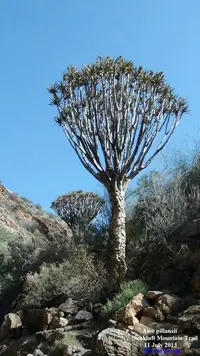
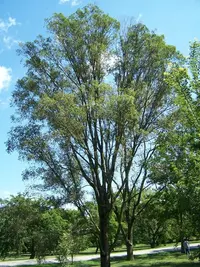
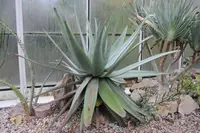
The giant quiver tree, Aloidendron pillansii, is a slow-growing succulent tree from arid regions of South Africa and Namibia. It forms a thick, branching trunk crowned with stiff, upright, blue-green leaves. Mature plants develop a striking sculptural silhouette and rough, cracked bark that helps protect the stem in harsh sun and drought. Flowers appear in dense clusters near branch tips, attracting pollinators in its native habitat. This species is highly adapted to very dry, bright conditions, which makes it sensitive to overwatering and poor drainage in cultivation. Gardeners who learn how to care for Giant Quiver Tree usually focus on strong light, minimal watering, and very free-draining, mineral-rich soil.

Care Difficulty
Hard Care

Light Preference
Full Sun

Water Requirements
Low Water

Temperature Preference
Tropical / Frost Sensitive

Hardiness Zone
10–11

Soil Texture
Sandy, Rocky, Loamy

Soil pH
Slightly acidic (6.5–7.0), Neutral (7.0)

Soil Drainage
Well-drained

Fertilization
Minimal (feed rarely)
Scan your plant to receive care tips personalized for your specific plant
Available on iOS and Android
Aloidendron pillansii needs intense, dry-climate sun but must acclimate slowly to avoid scorch.
This species is highly drought-tolerant and must be kept on the dry side to prevent root damage.
This desert tree prefers hot, dry conditions and is not suited to cold or humid climates.
This desert succulent tolerates very dry air and rarely needs humidity adjustments indoors.
This species needs a very fast-draining, mineral-rich substrate that mimics arid, rocky slopes.
This species can be grown in containers when strict control of drainage and stability is provided.
This very slow-growing desert tree needs only light, infrequent feeding in containers or poor soils.
Pruning Aloidendron pillansii is minimal and mainly corrective, aimed at maintaining safety and structure.
Transplanting this long-lived desert tree is rare and should be done only when clearly necessary.
Propagation of Aloidendron pillansii is specialized and usually left to experienced growers or conservation programs.
This arid-climate tree is not reliably hardy in cold, wet winters and needs protection in most temperate regions.

Plant Health Check
Not sure what's wrong with your plant? Check your plant's health inside the app.
This species is a Tertiary relict, surviving from much wetter ancient climates and now restricted to a few extremely arid valleys in the Richtersveld region of South Africa and adjacent Namibia.
Its pale, waxy leaves use crassulacean acid metabolism (CAM), a photosynthetic pathway that allows stomata to open mostly at night, reducing water loss while still absorbing carbon dioxide.
Wild plants occur in highly localized, fragmented populations on specific rocky slopes and plains, making the species vulnerable to climate shifts and contributing to its listing as Endangered in South Africa.

Mature individuals can reach 7–10 m in height and may be several hundred years old, forming tree-sized silhouettes in the desert that historically served as prominent navigation markers for local pastoralists.
Growth is very slow. In suitable arid, frost-free conditions it may add only a few centimeters in height per year. Seedlings and young plants often appear almost unchanged for several years before any noticeable trunk development.
Keep your plants happy and healthy with plant identification, disease detection, and easy care guidance.