Rhizome Division
Divide older clumps every 3–4 years by lifting the rhizomes, cutting away woody, congested sections, and replanting only firm, pale segments with several growing buds to maintain vigor and yield usable rhizomes.

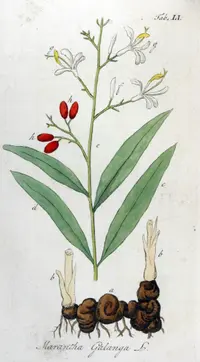
Galangal (Alpinia galanga) is a perennial rhizomatous herb in the ginger family, grown mainly for its aromatic underground stems. It forms upright clumps of tall, cane-like shoots with narrow, glossy green leaves and can produce white to pale pink flowers followed by small red fruits in suitable climates. Native to Southeast Asia, it prefers warm, humid conditions and thrives in frost-free outdoor gardens or protected containers. The plant is moderately easy to grow if its need for consistent warmth, moisture, and free-draining, organically rich soil is met. Understanding how to care for Galangal helps keep the foliage healthy and encourages steady rhizome production over several years.

Care Difficulty
Moderate Care

Light Preference
Partial Sun

Water Requirements
Regular Water

Temperature Preference
Tropical / Frost Sensitive

Hardiness Zone
9–12

Soil Texture
Loamy, Sandy, Organic-rich

Soil pH
Acidic (5.5–6.5), Slightly acidic (6.5–7.0)

Soil Drainage
Moist but well-drained

Fertilization
Moderate (every 2–4 weeks)
Scan your plant to receive care tips personalized for your specific plant
Available on iOS and Android
This rhizomatous perennial prefers bright, indirect light with some gentle direct sun.
This species prefers consistently moist but not waterlogged soil around its shallow rhizomes.
This tropical ginger grows best in warm, frost-free conditions year-round.
This species prefers moderately humid air and may struggle in very dry homes.
This plant grows best in loose, moist, organic-rich soil that drains freely yet does not dry out quickly.
This species adapts well to container growing when given enough root volume and stable moisture.
Nutrient-rich soil supports strong growth and rhizome production in Galangal.
Pruning Alpinia galanga is mainly hygienic and shaping rather than heavy structural work.
Alpinia galanga forms spreading rhizomes that eventually crowd pots or planting spaces.
Alpinia galanga is most reliably propagated by dividing rhizomes rather than from seed.
Alpinia galanga is frost-tender and needs protection in regions with cold winters.

Plant Health Check
Not sure what's wrong with your plant? Check your plant's health inside the app.
The rhizomes are rich in aromatic compounds such as 1,8-cineole and methyl cinnamate, which give them a sharper, more peppery scent and flavor than ginger and make them essential in many Thai and Indonesian curry pastes.
This species forms tall, clumping stands up to around 2 m in cultivation, with leafy pseudostems that arise from underground rhizomes rather than true woody stems, a typical feature of many members of the ginger family Zingiberaceae.
Although it produces attractive white flowers with reddish markings, the plant is often propagated by division of rhizomes because viable seed production is relatively uncommon in cultivated settings, especially outside its native range.

Large stands of Alpinia galanga have been traditionally cultivated in parts of Southeast Asia not only as a spice crop but also as living windbreaks and boundary markers around fields, using the tall, dense clumps to shelter more delicate crops from strong winds.
Brown leaf tips or edges usually come from low humidity, fertilizer burn, or inconsistent watering. Check for salt buildup in the pot, flush the soil, trim damaged tips, and stabilize moisture levels to prevent further browning.
Keep your plants happy and healthy with plant identification, disease detection, and easy care guidance.