Spring sowing timing
Sow seeds outdoors as soon as soil is workable and night frosts start to ease, so seedlings experience cool conditions that match this annual’s natural early-spring growth cycle.

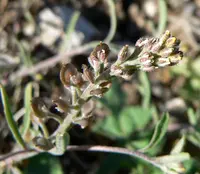
Desert madwort, Alyssum desertorum, is a small annual in the mustard family that forms low, spreading clumps. It produces clusters of tiny yellow flowers above narrow, gray-green foliage. Native to arid and semi-arid regions of Eurasia, it often grows on dry slopes, gravelly ground, and disturbed sites. The plant is adapted to poor, well-drained soils and short spring moisture. It usually grows quickly, sets seed, and then declines as heat and drought increase. These traits make it relatively simple to establish in suitable dry, sunny locations, but less reliable in humid or poorly drained conditions for those who want to learn how to care for desert madwort.

Care Difficulty
Easy Care

Light Preference
Full Sun

Water Requirements
Low Water

Temperature Preference
Cold Hardy

Hardiness Zone
4–9

Soil Texture
Sandy, Loamy, Rocky

Soil pH
Slightly acidic (6.5–7.0), Slightly alkaline (7.0–7.5)

Soil Drainage
Well-drained

Fertilization
Minimal (feed rarely)
Scan your plant to receive care tips personalized for your specific plant
Available on iOS and Android
This compact annual thrives in open, bright locations typical of dry, rocky habitats.
This species prefers dry, fast-draining conditions and is sensitive to excess moisture.
This plant is adapted to wide temperature swings typical of continental and semi-desert climates.
This species thrives in dry air and does not need raised humidity.
This plant prefers mineral, sharply drained soil that mimics dry, rocky habitats.
This species is suitable for container growing, especially in shallow, fast-draining pots.
This drought-adapted annual needs only modest feeding, so focus on light, infrequent nutrition during active growth.
Pruning Alyssum desertorum is mainly about tidying plants and encouraging a compact, floriferous mound.
This species is most often grown as a short-lived annual, so transplanting young plants is more common than long-term repotting.
Alyssum desertorum is most commonly propagated by seed, which maintains its natural, compact habit.
This species is generally cold tolerant but often behaves as an annual, so winter care is minimal in most climates.

Plant Health Check
Not sure what's wrong with your plant? Check your plant's health inside the app.
This species is a true desert ephemeral, completing its entire life cycle quickly in early spring while soil moisture from snowmelt is still available, then disappearing as summer drought arrives.
Alyssum desertorum often grows on dry, rocky, or sandy sites with relatively high salinity, showing notable tolerance to both water scarcity and soil salts compared with many other small annual herbs.
Although native to arid regions of Eurasia, this species is now naturalized in parts of western North America, where it colonizes disturbed sites such as roadsides and overgrazed rangeland.

In some semi-arid steppe communities of Central Asia, dense spring carpets of Alyssum desertorum flowers provide an important early-season nectar and pollen source for solitary bees emerging from winter dormancy.
Lack of flowers usually comes from too much shade, overly rich or wet soil, or old, woody plants. Provide full sun, avoid heavy fertilizing, and shear lightly after flowering to stimulate fresh growth and future buds.
Keep your plants happy and healthy with plant identification, disease detection, and easy care guidance.