Use stable substrate
Attach fragments only to hard, long-lasting materials such as untreated stone, tile, or unglazed clay, since this crustose lichen bonds permanently to the surface and cannot be moved later without damage.

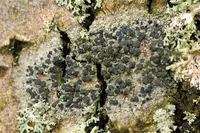
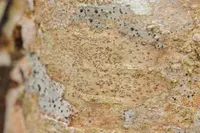
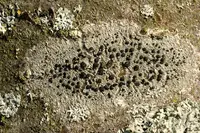
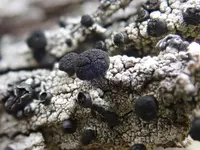
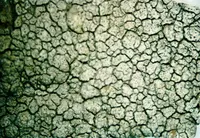
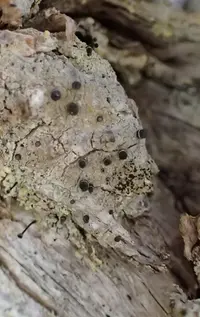
Tiny button lichen (Amandinea punctata) is a crustose lichen, not a true plant, forming flat, closely attached patches on bark, rocks, and man-made surfaces. Its thallus, or lichen body, appears as small, dark, button-like discs scattered over a gray to brown crust.
This species occurs widely in temperate regions, including urban areas, and tolerates air pollution and variable moisture. It grows slowly but is persistent once established.
Because it is adapted to harsh, exposed habitats, it is relatively undemanding in cultivation but difficult to start from scratch. Those who wish to learn how to care for Tiny button lichen usually focus on providing stable surfaces, gentle moisture, and good air circulation rather than intensive care.

Care Difficulty
Easy Care

Light Preference
Full Sun

Water Requirements
Low Water

Temperature Preference
Cold Hardy

Hardiness Zone
3–9

Soil Texture
Rocky, Sandy, Loamy

Soil pH
Slightly acidic (6.5–7.0), Neutral (7.0)

Soil Drainage
Well-drained

Fertilization
Minimal (feed rarely)
Scan your plant to receive care tips personalized for your specific plant
Available on iOS and Android
This crustose lichen thrives in bright, open conditions but tolerates some shade on tree bark, rocks, and man-made surfaces.
This species does not need intentional watering and relies on natural rainfall and humidity.
This lichen is highly cold-hardy and heat-tolerant across a wide outdoor temperature range.
This crustose lichen tolerates a wide humidity range but benefits from steady ambient moisture.
Amandinea punctata anchors to firm, mineral surfaces, so soil use is mainly for mounting fragments or mimicry in containers.
This species is not naturally suited to conventional container growing, but shallow, stony dishes can support display colonies.
Amandinea punctata, commonly known as tiny button lichen, grows on nutrient-poor bark or rock and does not benefit from conventional fertilization.
Amandinea punctata requires no true pruning, only minimal cleaning of its substrate when necessary.
This lichen is usually left undisturbed, but careful transplanting is possible when needed for study or display.
Propagation of Amandinea punctata is specialized and generally left to researchers or advanced enthusiasts.
This lichen is naturally cold hardy and needs no special winter care in typical outdoor conditions across temperate regions.

Plant Health Check
Not sure what's wrong with your plant? Check your plant's health inside the app.
This crustose lichen is one of the few common species that tolerates moderate urban air pollution and often colonizes roadside trees, old fence posts, and weathered concrete and mortar.
The species forms very small, round, black fruiting bodies called apothecia that are often crowded and slightly immersed in the gray to brown thallus, making the surface appear peppered or dotted.
Amandinea punctata occurs on bark of many tree genera, but also on siliceous rock, calcareous rock, and man-made substrates, which contributes to its almost cosmopolitan distribution.

Molecular and morphological studies have shown that specimens once treated as several separate species from different continents actually belong to Amandinea punctata, revealing that this inconspicuous lichen has a remarkably wide global range from temperate to some subpolar regions.
Growth is very slow. Thallus patches usually expand only 0.5–2 mm per year, depending on moisture, air quality, and surface stability. Expect visible change over several years rather than months when growing Tiny button lichen on new substrates.
Keep your plants happy and healthy with plant identification, disease detection, and easy care guidance.