Select stable substrate
Establish colonies on stable, non-flaking bark or well-seasoned hardwood where the surface will not peel or crack quickly, since this lichen relies on long-term contact with the same substrate.

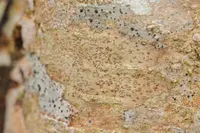
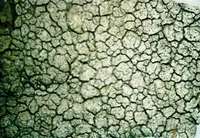
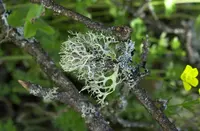
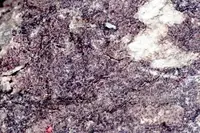
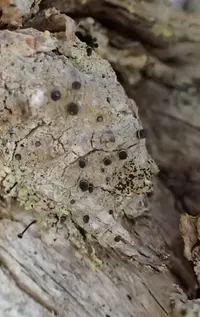
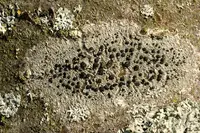
Coniocarpon cinnabarinum is not a typical garden plant but a crust-like lichen that grows tightly attached to tree bark, especially on smooth-barked deciduous trees. Its surface shows orange to red patches, giving a distinctive cinnabar tone.
This species occurs mainly in temperate regions of Europe and parts of North America, usually in clean, humid woodlands. It is sensitive to air pollution and habitat disturbance, so it is not easy to cultivate deliberately.
Those who attempt to care for Coniocarpon cinnabarinum need to mimic its natural conditions: stable humidity, clean air, and shaded, bark-like surfaces. It is better observed and appreciated in nature than managed as a conventional houseplant.

Care Difficulty
Moderate Care

Light Preference
Partial Shade

Water Requirements
Moderate Water

Temperature Preference
Cool Climate

Hardiness Zone
Unknown

Soil Texture
Loamy

Soil pH
Slightly acidic (6.5–7.0)

Soil Drainage
Well-drained

Fertilization
Minimal (feed rarely)
Scan your plant to receive care tips personalized for your specific plant
Available on iOS and Android
This crustose lichen prefers cool, stable light conditions rather than intense direct sun.
Moisture for this lichen should come mainly from ambient humidity, rain, and occasional surface dampness rather than heavy, directed watering.
This lichen is adapted to cool to mild climates with gradual, not sudden, temperature changes.
Humidity plays a minor role for Coniocarpon cinnabarinum, which tolerates a broad range if extremes are avoided.
Soil conditions are usually irrelevant because this lichen naturally anchors to bark or rock rather than rooting in substrate.
This species is not naturally suited to conventional container growing, but it can be maintained on stable supports placed in shallow trays or pots for observation.
This lichenized fungus typically grows on nutrient-poor bark and does not benefit from additional fertilization in cultivation.
Pruning is not applicable for Coniocarpon cinnabarinum, as it is a crustose lichen rather than a typical garden plant.
Transplanting this crustose lichen from its natural substrate is rarely successful and generally not recommended.
Propagation of this species is specialized and not suitable for routine home culture, so practical Coniocarpon cinnabarinum plant care does not include propagation steps.
This bark-dwelling lichen is naturally cold hardy in its native range and generally needs no special winter care.

Plant Health Check
Not sure what's wrong with your plant? Check your plant's health inside the app.
This species forms tiny, bright orange to cinnabar-red reproductive structures called perithecia that are embedded in a thin crust on wood, giving fallen logs a striking speckled appearance.
It grows almost exclusively on decaying, often barkless hardwood and conifer wood, contributing to the breakdown of lignocellulose, the complex structural material in plant cell walls.
The species is mainly recorded from parts of Europe, where it is considered uncommon and often appears in well-structured, older woodlands with a steady supply of dead timber.
This crust-like lichen does not adapt well to typical indoor conditions. It develops best outdoors on shaded, consistently damp, undisturbed bark or wood in clean air, where natural humidity, light, and substrates are stable over many years.
Keep your plants happy and healthy with plant identification, disease detection, and easy care guidance.