Host tree selection
Establish this ectomycorrhizal fungus under compatible host trees such as birch, pine, or spruce, and avoid sites dominated by non-mycorrhizal ornamentals or heavy turf management to improve long-term colonization success.

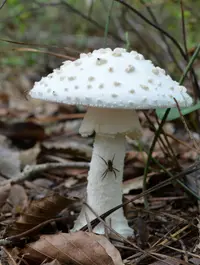
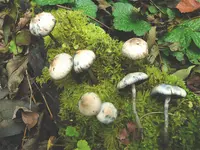
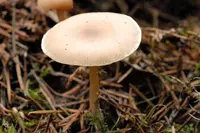
Golden Threads Lepidella is the common name for Amanita canescens, a small to medium gilled fungus rather than a leafy houseplant. It produces pale gray to whitish caps with fine, threadlike surface patterns and a slender stem, often appearing in groups.
This species is typically found in forests of North America, growing on soil in association with tree roots. It has a specialized life cycle and depends on specific tree partners, which makes it difficult to cultivate intentionally and not suitable as a typical indoor or garden plant. For anyone curious about how to care for Golden Threads Lepidella, the focus is mainly on conserving its woodland habitat rather than growing it in containers.

Care Difficulty
Hard Care

Light Preference
Partial Shade

Water Requirements
Regular Water

Temperature Preference
Cool Climate

Hardiness Zone
Unknown

Soil Texture
Loamy, Sandy, Organic-rich

Soil pH
Acidic (5.5–6.5)

Soil Drainage
Moist but well-drained

Fertilization
Minimal (feed rarely)
Scan your plant to receive care tips personalized for your specific plant
Available on iOS and Android
Amanita canescens, often called Golden Threads Lepidella, is a ground-dwelling fungus that prefers moderated, indirect light in woodland settings.
Amanita canescens relies on naturally moist, not saturated, woodland soil rather than frequent direct watering.
This woodland fungus prefers cool to mild conditions and is sensitive to both hard frost and extreme heat.
This species is not suited to indoor cultivation, and specific humidity control is generally unnecessary outdoors.
This ectomycorrhizal fungus relies on natural forest soil conditions rather than prepared mixes.
This species is not suitable for container growing, as it depends on complex symbiosis with tree roots in undisturbed ground.
Amanita canescens is a wild mycorrhizal fungus that does not benefit from conventional fertilization, so added nutrients are usually unnecessary for caring for Golden Threads Lepidella.
Pruning is not applicable to Amanita canescens, as it is a wild mushroom forming seasonal fruiting bodies rather than a woody or leafy plant.
Transplanting Amanita canescens is generally impractical, because it depends on a mycorrhizal partnership with host tree roots in undisturbed soil.
Propagation of Amanita canescens is specialized and not suited to typical home methods, because it relies on complex mycorrhizal relationships with host trees.
Specific winter care for Amanita canescens is not needed, as this wild fungus persists underground as mycelium and fruits only in suitable seasons.

Plant Health Check
Not sure what's wrong with your plant? Check your plant's health inside the app.
This species often shows fine grayish veil fragments on the cap and upper stem, which helps distinguish it from similar pale amanitas that lack such persistent remnants.
It typically forms ectomycorrhizal partnerships with oak species in dry, sandy or well-drained soils, exchanging mineral nutrients for sugars from the tree roots.
Amanita canescens is primarily recorded from parts of North America, especially in eastern and central regions, and is not known as a widespread species on other continents.
This species is considered a poisonous amanita and should never be eaten. Ingestion may cause serious gastrointestinal and neurological symptoms in humans and pets. Keep children and animals away from fresh or dried fruiting bodies at all times.
Keep your plants happy and healthy with plant identification, disease detection, and easy care guidance.