
Host tree focus
Establish and maintain suitable ectomycorrhizal host trees such as oaks or pines, since this fungus relies on living roots rather than isolated substrate or indoor containers.

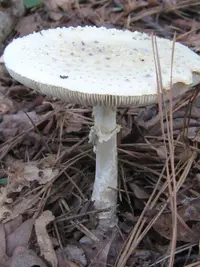
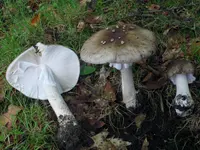
Coker's amanita (Amanita cokeri) is a large, gilled mushroom rather than a green plant. It forms stout white stems with broad caps often marked by pale warts or patches. The species grows on the ground in forests, usually near oaks or other hardwoods, across parts of eastern North America.
It lives in a mycorrhizal relationship, meaning it must partner with tree roots and cannot be grown in a typical pot or garden bed. Because of this dependency, attempts to care for Coker's amanita at home are usually unsuccessful.
In nature it favors moist, shaded woodland soils rich in leaf litter, appearing during warm, wet periods.

Care Difficulty
Hard Care

Light Preference
Partial Shade

Water Requirements
Keep Soil Moist

Temperature Preference
Cool Climate

Hardiness Zone
Unknown

Soil Texture
Loamy, Sandy, Organic-rich

Soil pH
Acidic (5.5–6.5)

Soil Drainage
Moist but well-drained

Fertilization
Minimal (feed rarely)
Scan your plant to receive care tips personalized for your specific plant
Available on iOS and Android
This ectomycorrhizal fungus develops best under woodland light conditions rather than open, direct sun.
Moist but not waterlogged soil around the tree roots is critical for stable Amanita cokeri associations.
This species prefers mild to warm conditions with cool, stable soil temperatures under tree cover.
Humidity is not a primary controllable factor for Amanita cokeri, which grows outdoors in natural forest conditions.
This ectomycorrhizal fungus depends on natural forest soil conditions rather than prepared mixes.
This species is not suitable for container growing because it requires complex, stable associations with living tree roots in natural soil.
This mycorrhizal fungus occurs naturally with trees and generally does not need added fertilizer for healthy growth.
Pruning is not applicable to Amanita cokeri, as it is a wild mushroom rather than a woody or leafy ornamental plant.
This species is not suited to typical garden repotting or transplanting because it depends on living tree roots in natural soil.
Deliberate propagation of this woodland mushroom is technically complex and not recommended for home growers.
This native woodland fungus overwinters in soil with its tree partners and usually requires no special winter care from gardeners.

Plant Health Check
Not sure what's wrong with your plant? Check your plant's health inside the app.
Mature mushrooms usually show a thick, skirt-like double ring on the upper stem, a feature that helps distinguish this species from many other white amanitas in the field.
The cap often carries large, irregular cottony patches and warts that may wash or fall off with age or rain, making older specimens look much smoother than young ones.
This species forms ectomycorrhizal partnerships with trees, especially oaks in the southeastern United States, exchanging mineral nutrients from the soil for sugars from the host tree.
Amanita cokeri was named in honor of the American mycologist William Chambers Coker, who made major contributions to the study of North American fungi, particularly in the southeastern United States.
This mushroom is considered highly toxic. Ingestion can cause severe gastrointestinal and nervous system symptoms, and can be fatal to pets and people. It should never be eaten, handled with food, or encouraged where children or animals forage.
Keep your plants happy and healthy with plant identification, disease detection, and easy care guidance.
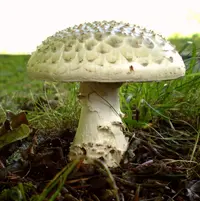
Solitary Amanita
Amanita echinocephala
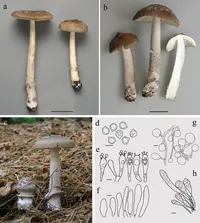
Shaggy Legged Ringless Amanita
Amanita rhacopus
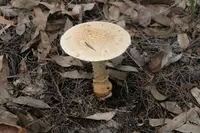
Ocher-Gilled Barefoot Lepidella
Amanita ochrophylla
Bay Bolete
Imleria badia
False Caesar's Mushroom
Amanita parcivolvata
Rose-Tinted Amanita
Amanita roseotincta
Orange Grisette
Amanita crocea
Ball Gown Amanita
Amanita submaculata