Mycorrhizal partner protection
Avoid disturbing or compacting the soil within the dripline of the host tree, since the fungal mycelium forms a delicate network there that is essential for growing Ball Gown Amanita successfully.

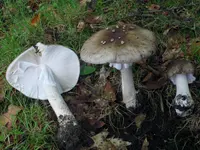
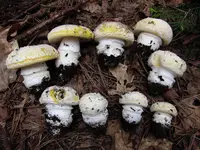
Ball gown amanita, Amanita submaculata, is a gilled mushroom rather than a leafy houseplant. It produces smooth, pale to yellowish caps with scattered small patches, a slender stem, and typical amanita features like a ring and volva at the base.
This species is native to North America and is usually found in woodlands, growing on the ground in association with tree roots. It forms mycorrhizal relationships, meaning it relies on living trees for nutrients, so it cannot be grown like a normal potted plant. Anyone looking up how to care for Ball Gown Amanita should treat it primarily as a wild fungus of interest, not as a practical cultivation candidate.

Care Difficulty
Hard Care

Light Preference
Partial Shade

Water Requirements
Keep Soil Moist

Temperature Preference
Warm Climate

Hardiness Zone
Unknown

Soil Texture
Loamy, Organic-rich

Soil pH
Slightly acidic (6.5–7.0)

Soil Drainage
Moist but well-drained

Fertilization
Minimal (feed rarely)
Scan your plant to receive care tips personalized for your specific plant
Available on iOS and Android
Amanita submaculata, often called Ball Gown Amanita, is a woodland fungus that prefers dappled forest light rather than direct sun.
Amanita submaculata needs consistently moist, but not waterlogged, soil to support its mycelium in the upper soil layers.
This woodland species favors mild conditions and does best in cool to moderately warm climates.
This fungus has specific moisture needs in its natural habitat, but indoor air humidity is usually a minor factor.
Amanita submaculata depends on living trees and natural forest soil rather than prepared potting mixes.
This species is not suitable for container growing because it relies on complex root partnerships in natural woodland soils.
Amanita submaculata forms natural nutrient partnerships in soil and should not be fertilized in managed settings.
Amanita submaculata is a wild mycorrhizal fungus and is not pruned as a garden or houseplant species.
As a mycorrhizal fungus, Amanita submaculata is not suited to container culture or typical repotting routines.
Propagation of Amanita submaculata is specialist work and not recommended for typical home cultivation.
This wild ectomycorrhizal fungus is naturally adapted to local winter conditions and needs no targeted winter care from gardeners.

Plant Health Check
Not sure what's wrong with your plant? Check your plant's health inside the app.
This species is native to eastern North America, where it has been documented from Canada south into the United States, typically in temperate forest regions rather than in western or tropical habitats.
Mature fruiting bodies often show irregular pale spots or maculations on the cap surface, a feature referenced by the epithet submaculata and used by mycologists to help separate it from more uniformly colored, closely related Amanita species.
Field observations place this mushroom most often in association with hardwood trees such as oaks, indicating a preference for broadleaf forest communities over purely coniferous stands.
Yes. This species is considered highly poisonous to both humans and animals. Ingestion can cause severe gastrointestinal, liver, and nervous system damage. All parts should be treated as toxic and strictly kept away from children and pets.
Keep your plants happy and healthy with plant identification, disease detection, and easy care guidance.