Spore Print Monitoring
Regularly take spore prints from mature caps on clean paper to document local populations and help track seasonal fruiting patterns year to year when caring for Constricted Grisette.

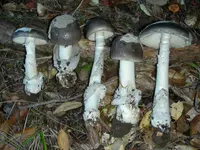
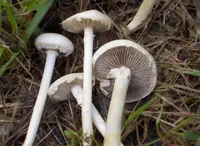
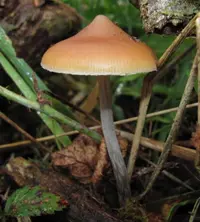
Constricted grisette, Amanita constricta, is a small to medium mushroom rather than a leafy houseplant. It forms slender stems with pale caps that often show a constricted ring zone near the top of the stalk. Caps are usually grayish to brownish with a smooth to slightly patchy surface. It grows on the ground in woodland habitats, typically near trees, where it forms mycorrhizae, a nutrient-trading partnership with roots.
In cultivation, it is difficult to maintain because it depends on this close tree association and specific soil fungi. Its growth is not easily controlled in pots or standard garden beds, so attempts to care for Constricted Grisette at home generally have low success.

Care Difficulty
Hard Care

Light Preference
Partial Shade

Water Requirements
Keep Soil Moist

Temperature Preference
Warm Climate

Hardiness Zone
Unknown

Soil Texture
Loamy, Sandy, Organic-rich

Soil pH
Acidic (5.5–6.5)

Soil Drainage
Moist but well-drained

Fertilization
Minimal (feed rarely)
Scan your plant to receive care tips personalized for your specific plant
Available on iOS and Android
This ectomycorrhizal fungus relies on dappled woodland light rather than direct, open sun.
This woodland fungus depends on consistently moist, not waterlogged, soil and litter around its host trees.
This species is adapted to mild to warm woodland climates with moderate seasonal shifts.
Humidity is not a practical care factor for Amanita constricta, since this wild ectomycorrhizal fungus cannot be reliably maintained in typical home conditions.
This fungus depends on natural, undisturbed soil and tree roots, so direct manipulation of soil in pots or beds rarely supports Amanita constricta.
This species is not suitable for container growing, as it requires complex mycorrhizal relationships with host tree roots in undisturbed ground.
This ectomycorrhizal fungus relies on its tree host for nutrients, so direct fertilization of Amanita constricta is neither necessary nor recommended.
Pruning is not applicable to Amanita constricta, as it is a wild mycorrhizal fungus rather than a plant grown for structured foliage or flowers.
This species is not suited to container culture, so focus on minimizing disturbance rather than attempting to repot or transplant Amanita constricta.
Deliberate propagation of this ectomycorrhizal fungus is complex and rarely attempted outside research settings, so home methods are not practical.
No active winter care is needed, as this wild fungus persists underground and fruits only under suitable seasonal conditions.

Plant Health Check
Not sure what's wrong with your plant? Check your plant's health inside the app.
This species is native to southeastern Australia and typically forms ectomycorrhizal associations with eucalypts, exchanging mineral nutrients and water from the soil for sugars produced by the tree.
It is distinguished by a prominent, constricted ring on the upper stem, where the partial veil attaches, giving the species its name and helping to separate it from other small, pale amanitas in the field.
Unlike many amanitas with sticky or slimy caps when wet, this species has a dry, often slightly powdery cap surface, which is a key macroscopic trait used by mycologists to confirm identification.
This species is considered inedible and potentially poisonous. Identification within the Amanita group is difficult, and some close relatives are deadly. For safety, it should never be eaten or used as a food source.
Keep your plants happy and healthy with plant identification, disease detection, and easy care guidance.