Site hygiene management
Remove and dispose of old caps and decaying fruiting bodies promptly so fungal energy is redirected to healthy mycelium and to reduce attraction of fungus gnats and other insects around the patch.

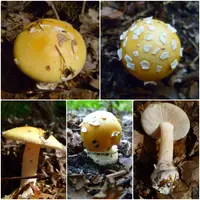
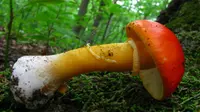
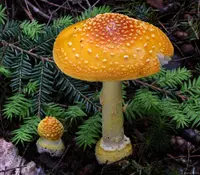
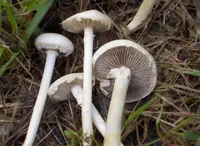
Gemmed Amanita (Amanita gemmata) is a small, mycorrhizal mushroom, not a houseplant, most often found in forest soils near conifer and mixed woods. It typically shows a pale yellow to cream cap with scattered whitish warts and a slender stem with a ring and a distinct volva at the base. This species occurs across temperate regions, including parts of North America and Europe, usually fruiting in moist, undisturbed habitats. Because it depends on a symbiotic relationship with tree roots, it is not suitable for typical indoor cultivation and is very difficult to grow intentionally. Any attempt to care for gemmed Amanita should focus on preserving natural woodland conditions rather than treating it as a potted plant.

Care Difficulty
Hard Care

Light Preference
Partial Shade

Water Requirements
Keep Soil Moist

Temperature Preference
Cool Climate

Hardiness Zone
Unknown

Soil Texture
Loamy, Sandy, Organic-rich

Soil pH
Acidic (5.5–6.5)

Soil Drainage
Moist but well-drained

Fertilization
Minimal (feed rarely)
Scan your plant to receive care tips personalized for your specific plant
Available on iOS and Android
This ectomycorrhizal mushroom prefers bright forest conditions without direct, harsh sun.
This fungus depends on consistently moist, well-drained forest soil rather than direct watering of the fruiting bodies.
This species fruits best in mild, temperate conditions with cool nights and moderate days.
Humidity is not a primary limiting factor for Amanita gemmata, which grows outdoors in variable forest air conditions.
This species relies on specific outdoor forest soil conditions and cannot be reliably grown in standard garden or potting mixes.
This species is not suitable for growing in containers because it depends on complex mycorrhizal relationships with tree roots in natural soil.
In natural settings, Amanita gemmata forms nutrient-exchanging partnerships with tree roots and does not benefit from direct fertilization.
Pruning is not applicable to Amanita gemmata because it is a mushroom, not a woody or leafy plant.
Transplanting is generally unsuitable for Amanita gemmata, which depends on a stable mycorrhizal relationship with host tree roots.
Propagation of Amanita gemmata is specialized and not practical for home growers.
As a wild mycorrhizal fungus, Amanita gemmata requires no dedicated winter care in garden or woodland settings.

Plant Health Check
Not sure what's wrong with your plant? Check your plant's health inside the app.
This species contains both ibotenic acid and muscimol, but also muscarine in low but measurable amounts, giving it a more complex and potentially dangerous toxicity profile than the better known fly agaric.
Amanita gemmata occurs across Europe, parts of Asia, North Africa, and North America, but tends to appear in scattered, localized populations tied closely to suitable coniferous or mixed woodland habitats.
This fungus forms ectomycorrhizal partnerships with conifers such as pine and spruce, exchanging mineral nutrients for tree sugars and often appearing at the edges of forest clearings or paths where roots are abundant.

Historical field guides and regional floras have often confused this species with similar yellow amanitas, such as Amanita junquillea and pale forms of Amanita muscaria, so older records of its distribution and abundance are considered unreliable and are being reassessed using modern identification criteria.
This mushroom is highly toxic to both humans and animals. Ingestion can cause serious neurological and gastrointestinal symptoms. It must never be eaten or handled by children or pets, and all specimens should be kept out of reach.
Keep your plants happy and healthy with plant identification, disease detection, and easy care guidance.