Use Aged Hardwood
Select well-rotted oak, beech, or other hardwood already colonized by fungi or softened by decay, as Chlorociboria aeruginosa establishes far more reliably on decomposed wood than on fresh logs or lumber.

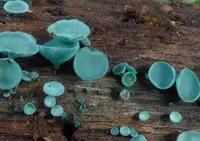
Turquoise elfcup, Chlorociboria aeruginosa, is not a typical houseplant but a small wood-decay fungus best known for its striking blue-green stained wood. It forms tiny cup-shaped fruiting bodies on fallen, damp hardwood, often hidden among leaf litter in forests.
This species occurs mainly in temperate regions, including parts of North America and Europe, wherever well-rotted wood stays moist and shaded. Because it depends on decaying wood and stable humidity, it is challenging to cultivate indoors, and attempts to care for Turquoise Elfcup usually focus on maintaining naturally rotting wood in controlled, cool, shaded conditions.

Care Difficulty
Hard Care

Light Preference
Shade

Water Requirements
Keep Soil Moist

Temperature Preference
Cool Climate

Hardiness Zone
Unknown

Soil Texture
Loamy, Silty, Organic-rich

Soil pH
Strongly acidic (4.5–5.5), Acidic (5.5–6.5)

Soil Drainage
Moist but well-drained

Fertilization
Minimal (feed rarely)
Scan your plant to receive care tips personalized for your specific plant
Available on iOS and Android
This wood-inhabiting fungus prefers cool, shaded forest conditions rather than direct sun exposure.
This species grows on decaying wood and depends on consistent ambient moisture rather than direct watering.
This fungus is adapted to cool, temperate forest climates with moderate seasonal changes.
This wood-inhabiting fungus needs consistently moist, humid conditions to fruit well.
This species naturally colonizes damp, decaying hardwood rather than true garden soil.
This fungus can be maintained in containers if the setup mimics moist, decaying woodland wood.
Chlorociboria aeruginosa is a wood-decaying fungus that naturally requires no added fertilizer when growing on suitable dead hardwood.
Chlorociboria aeruginosa does not require pruning, as the visible cups are brief fruiting bodies on decaying wood, not a plant structure that benefits from shaping.
In cultivation, this fungus is best managed by refreshing its wood substrate rather than conventional repotting.
Propagation of Chlorociboria aeruginosa is specialized and usually handled by experienced growers or researchers rather than casual hobbyists.
Outdoor colonies of Turquoise Elfcup on native hardwood are generally cold hardy and need no special winter care in temperate climates.

Plant Health Check
Not sure what's wrong with your plant? Check your plant's health inside the app.
This species produces a stable blue-green pigment called xylindein that stains the wood it colonizes, creating the distinctive turquoise-colored “green oak” used by woodworkers and marquetry artists since at least the Renaissance.
It mainly colonizes well-decayed, fallen hardwoods, especially oak, and breaks down lignin and cellulose, helping recycle complex wood components back into forest nutrient cycles.
The fungus forms tiny turquoise, saucer-shaped fruiting bodies only a few millimeters across on the surface of stained wood, while most of its biomass remains hidden as fine threads (mycelium) within the timber.

Microscopic studies show that xylindein produced by this species penetrates deeply into wood cell walls, which helps explain why historical green-stained wood in European decorative objects can retain its vivid color for centuries with minimal fading.
Growth is slow. The fungus spreads gradually through fallen hardwood, often taking several seasons before the blue-green staining becomes extensive. Visible cups may appear sporadically and remain small, so it is not suitable for rapid ornamental coverage.
Keep your plants happy and healthy with plant identification, disease detection, and easy care guidance.