Spore Print Monitoring
Collect spore prints from mature caps on white and dark paper to track spore color and density, which helps verify correct identification and timing before disturbing the fruiting site.

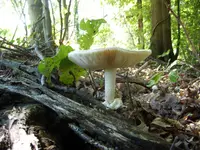
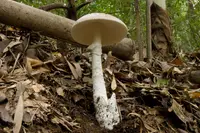
Ravenel's Lepidella (Amanita ravenelii) is a gilled mushroom, not a leafy houseplant. It forms sturdy stems topped with pale caps often dotted with whitish warts. The fruiting bodies emerge from the ground in forests, usually near hardwoods in the eastern United States, where the fungus lives in partnership with tree roots.
This species appears seasonally and does not adapt well to typical indoor or garden conditions. Because it relies on complex soil and root relationships, it is considered difficult to cultivate deliberately. For most people, attempts to care for Ravenel's Lepidella are limited to observing and not disturbing wild specimens.

Care Difficulty
Hard Care

Light Preference
Partial Shade

Water Requirements
Keep Soil Moist

Temperature Preference
Warm Climate

Hardiness Zone
Unknown

Soil Texture
Loamy, Organic-rich

Soil pH
Acidic (5.5–6.5)

Soil Drainage
Moist but well-drained

Fertilization
Minimal (feed rarely)
Scan your plant to receive care tips personalized for your specific plant
Available on iOS and Android
This ectomycorrhizal fungus prefers dappled woodland light rather than direct, open sun.
This species relies on consistently moist, not waterlogged, forest soil in partnership with tree roots.
This woodland fungus favors mild to warm conditions with protection from hard frost and extreme heat.
Humidity management is not a meaningful factor for this wild ectomycorrhizal fungus and is best left to its natural outdoor habitat rather than controlled indoor culture attempts like caring for Ravenel's Lepidella.
Amanita ravenelii fruits only in association with suitable tree hosts, so soil preparation focuses on supporting that woodland relationship rather than pot-style mixes.
This species is not suitable for container growing because its life cycle depends on complex, long-term associations with tree roots in natural soil profiles, which containers cannot realistically reproduce.
This mycorrhizal fungus associates with tree roots and generally does not benefit from direct fertilization in managed settings.
Pruning is not applicable to Amanita ravenelii, as it is a wild mycorrhizal mushroom rather than a cultivated garden plant.
This species is not suited to conventional repotting or transplanting, since the fungus depends on living tree roots and complex soil fungi networks.
Propagation of Amanita ravenelii is highly specialized and not recommended for typical home or garden conditions.
Specific winter care is not used for this wild ectomycorrhizal mushroom, which naturally experiences seasonal temperature changes in its woodland habitat.

Plant Health Check
Not sure what's wrong with your plant? Check your plant's health inside the app.
This species has a pale to yellowish cap covered with irregular, cottony white to yellow warts that are remnants of the universal veil, giving it a very rough, patchy appearance compared with many related amanitas.
When the gills or cap surface are bruised or age, the white flesh often stains pinkish to reddish, a reaction that helps field mycologists separate it from similar pale amanitas that do not show this color change.
It forms mycorrhizal partnerships with hardwoods, especially oaks, in the southeastern United States, where it is most often found in mixed or pure oak forests on the ground in summer and early autumn.

The species was named to honor American botanist and mycologist Henry William Ravenel, who made major contributions to the study of fungi in the southeastern United States in the 19th century.
This mushroom is considered poisonous and should never be eaten. It can cause serious gastrointestinal and neurological symptoms if ingested by people, dogs, or cats. Teach children not to touch wild mushrooms in lawns or woods.
Keep your plants happy and healthy with plant identification, disease detection, and easy care guidance.