
Spore-friendly raking
Lightly rake and loosen the upper 2–3 cm of leaf litter around host trees in late summer to early fall so developing fruiting bodies can push through the surface more easily without exhausting their energy reserves.

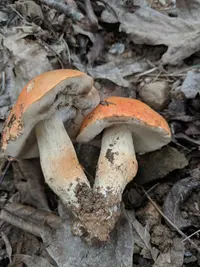
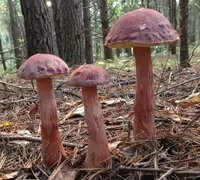
Burnt-orange bolete (Tylopilus balloui) is a wild mushroom-forming fungus, not a typical houseplant, most often noticed in forests rather than gardens. It forms sturdy, thick stems with a rounded cap in warm orange to rusty tones, and pores instead of gills on the cap underside.
This species usually appears on the ground in mixed or coniferous woods, often near trees it associates with through mycorrhiza, a nutrient-exchange partnership with roots. It is not commonly cultivated, so anyone wanting to care for Burnt-orange Bolete faces challenges due to its dependence on living host trees and natural forest conditions.
It generally prefers undisturbed, moist, well-drained, and slightly acidic forest soils with dappled light and stable humidity, rather than managed garden or indoor settings.

Care Difficulty
Hard Care

Light Preference
Partial Shade

Water Requirements
Keep Soil Moist

Temperature Preference
Cool Climate

Hardiness Zone
Unknown

Soil Texture
Loamy, Sandy, Organic-rich

Soil pH
Strongly acidic (4.5–5.5), Acidic (5.5–6.5)

Soil Drainage
Moist but well-drained

Fertilization
Minimal (feed rarely)
Scan your plant to receive care tips personalized for your specific plant
Available on iOS and Android
This ectomycorrhizal fungus prefers stable, forest-filtered light rather than open, direct sun.
This species depends on consistently moist, not saturated, forest soil supported by its tree partners.
This woodland fungus thrives in mild to warm conditions typical of temperate forests.
Humidity is not a meaningful care factor for Burnt-orange Bolete, which is a wild ectomycorrhizal mushroom rather than a typical cultivated plant.
Tylopilus balloui is not realistically managed through conventional soil preparation, as it is a wild ectomycorrhizal fungus that relies on complex partnerships with host tree roots.
This species is not suitable for container growing, as its life cycle depends on forming mycorrhizal relationships with trees in undisturbed soil.
This mycorrhizal fungus relies mainly on its tree partners and usually does not need intentional fertilization in gardens or natural settings.
Tylopilus balloui does not require pruning, since the visible mushroom is a short-lived fruiting body rather than a plant stem or shrub canopy.
This species forms underground symbiosis with tree roots, so care focuses on transplanting host trees or soil, not moving the fungus itself.
Practical propagation of Tylopilus balloui in home settings is unreliable, since it depends on complex mycorrhizal relationships with trees.
This fungus is naturally cold hardy in its native range and needs no specific winter care in the ground.

Plant Health Check
Not sure what's wrong with your plant? Check your plant's health inside the app.
The fruiting body has a distinctive burnt orange to cinnamon-brown cap, which is striking within a genus better known for duller brown or pinkish tones. This coloration can help separate it from closely related species in the field.
Its spores produce a pinkish-brown spore print, a useful diagnostic feature when distinguishing it from superficially similar boletes that have olive-brown or yellow-brown spore prints.
This species forms ectomycorrhizal associations with trees, especially in North American forests, exchanging mineral nutrients for sugars from the host roots. These partnerships help maintain soil health and forest nutrient cycling.
This species is generally considered inedible due to its very bitter taste. It is not recommended for consumption, even though it is not known as dangerously poisonous. Identification errors with similar boletes can also pose risks.
Keep your plants happy and healthy with plant identification, disease detection, and easy care guidance.