Cone selection
Use fully intact, recently fallen conifer cones that still feel firm and resinous, since older, decomposed cones hold less moisture and nutrients and will not support stable fruiting.

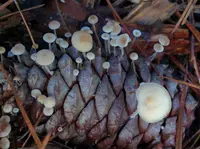
Conifercone cap (Baeospora myosura) is a small saprophytic fungus that fruits on old conifer cones, not a typical houseplant or garden specimen. Its tiny pale caps form dense clusters, giving a delicate, mossy look to decomposing cones on the forest floor.
This species is native to temperate conifer forests across the Northern Hemisphere, where it plays a role in breaking down woody debris. It is not commonly cultivated, but understanding how to care for Conifercone Cap helps owners of naturalistic terrariums or outdoor woodland beds mimic its cool, moist, shaded habitat. It prefers consistently damp, well-drained, organic-rich substrates with decaying conifer material present.

Care Difficulty
Hard Care

Light Preference
Shade

Water Requirements
Keep Soil Moist

Temperature Preference
Cool Climate

Hardiness Zone
Unknown

Soil Texture
Organic-rich, Loamy

Soil pH
Acidic (5.5–6.5)

Soil Drainage
Moist but well-drained

Fertilization
Minimal (feed rarely)
Scan your plant to receive care tips personalized for your specific plant
Available on iOS and Android
This small saprophytic fungus prefers low to moderate light typical of shaded conifer forests.
This fungus forms best on consistently moist, not saturated, conifer cones and surrounding litter.
This species is adapted to cool, temperate forest conditions rather than sustained heat.
Humidity is not a major factor for this small saprophytic fungus, which naturally fruits on dry conifer cones.
Baeospora myosura forms on decaying conifer cones rather than in typical garden soil.
This species is rarely grown in containers and is only moderately suitable when its natural cone substrate is replicated.
This small saprotrophic fungus grows on decaying conifer cones and generally does not benefit from added fertilizer.
Pruning is not part of normal care for Baeospora myosura, since the visible mushrooms are short‑lived fruiting bodies, not a woody plant canopy.
For practical purposes, treat this species as a wild decomposer rather than a container specimen, so transplanting focuses on its substrate, not individual mushrooms.
Propagation of this species is specialized and generally pursued only by mycologists, not typical home growers.
This fungus is naturally cold hardy in temperate forests and needs no deliberate winter care from the gardener.

Plant Health Check
Not sure what's wrong with your plant? Check your plant's health inside the app.
This tiny mushroom fruiting almost exclusively on old conifer cones, especially spruce, where it helps break down tough cone tissues and recycle nutrients back into the forest soil.
Its gills are extremely numerous and tightly packed, a diagnostic feature used by mycologists to separate it from other small cone-inhabiting fungi with fewer, more widely spaced gills.
In many temperate regions it fruits in late autumn to early winter, remaining active at low temperatures when much of the broader fungal community is already dormant.

Molecular studies have shown that this species, once grouped informally with various small white mushrooms, belongs to a distinct lineage within the Tricholomatineae, and its DNA-based placement helped clarify relationships among several other minute forest fungi.
This species is generally considered inedible due to its very small size, insubstantial flesh, and potential for confusion with other brownish mushrooms. It is not recommended for consumption and should be left for observation only.
Keep your plants happy and healthy with plant identification, disease detection, and easy care guidance.