Spore Print Monitoring
Regularly take spore prints from mature caps on white and dark paper to verify identification, track spore color consistency, and monitor the health and genetic stability of your culture over time.

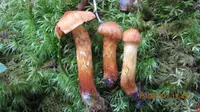
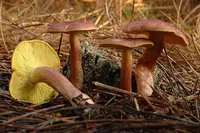
The sunset webcap, Aureonarius limonius, is a small woodland mushroom rather than a leafy houseplant. It produces rounded to bell-shaped caps in warm orange, rust, or yellow tones that deepen with age. The gills and stem often show similar sunset-like colors, giving the species its common name.
This fungus is typically found on the forest floor in temperate regions, growing among leaf litter or moss, usually in association with trees. It is not suited to regular home cultivation and is considered challenging to grow in controlled conditions, since it depends on complex relationships with tree roots and natural soil fungi. For most plant owners, learning how to care for sunset webcap is mainly about understanding its role in natural ecosystems, not raising it as an indoor specimen.

Care Difficulty
Hard Care

Light Preference
Partial Shade

Water Requirements
Moderate Water

Temperature Preference
Cool Climate

Hardiness Zone
Unknown

Soil Texture
Loamy, Sandy, Organic-rich

Soil pH
Acidic (5.5–6.5)

Soil Drainage
Moist but well-drained

Fertilization
Minimal (feed rarely)
Scan your plant to receive care tips personalized for your specific plant
Available on iOS and Android
This woodland fungus prefers gentle, filtered light rather than strong direct sun.
Moist, well-aerated soil is essential for stable fruiting of this mycorrhizal fungus.
This species is adapted to cool to mild woodland conditions and reacts poorly to extremes.
Humidity is not a major factor for Aureonarius limonius, which functions as a woodland fungus rather than a houseplant.
Aureonarius limonius grows in natural forest soil and is not realistically managed through conventional potting mixes.
This woodland fungus is not suitable for normal container growing.
This woodland fungus is adapted to low-nutrient conditions and does not need intentional fertilizing in gardens or containers.
Aureonarius limonius is not managed through pruning and should be left undisturbed in its natural habitat.
This mycorrhizal fungus should not be repotted or transplanted, as its survival depends on an undisturbed association with host tree roots.
Intentional propagation of Aureonarius limonius is highly specialized and not practical for home growers, so it is rarely attempted outside research settings.
This wild, cold-adapted fungus normally requires no special winter care and is best left to its natural seasonal cycle.

Plant Health Check
Not sure what's wrong with your plant? Check your plant's health inside the app.
The fruiting bodies show a characteristic yellow to orange-brown cap with a more vivid, almost sunset-like margin, which is one reason it was previously grouped within colorful Cortinarius species. This gradient coloration, combined with its fine fibrillose cap surface, helps distinguish it from duller, uniformly brown relatives in the same genus complex.
This fungus was moved from the large Cortinarius genus into Aureonarius after modern DNA-based studies reshaped cortinarioid taxonomy. Molecular phylogenetic work showed that it belongs in a more narrowly defined lineage characterized by yellowish pigments and specific microscopic traits.
The species forms ectomycorrhizae, a mutualistic association where the fungal hyphae coat and penetrate between root cells of host trees and exchange mineral nutrients for plant-derived sugars. It is typically associated with coniferous or mixed forests in temperate regions, contributing to soil nutrient cycling and tree health.
This fungus is not considered edible and should be treated as potentially poisonous. Identification in the Cortinariaceae family is difficult, and some close relatives contain dangerous toxins, so foraging or tasting is strongly discouraged.
Keep your plants happy and healthy with plant identification, disease detection, and easy care guidance.