Host tree selection
Establish this mycorrhizal fungus near compatible host trees such as oaks and related hardwoods, as fruiting is far more reliable when its underground mycelium can form stable associations with suitable roots.

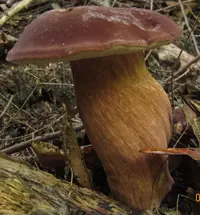
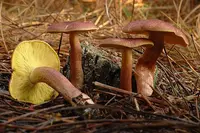
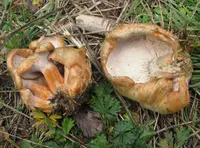
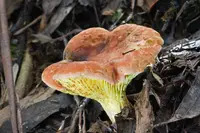
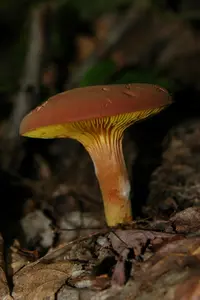
Tylopilus badiceps is not a true plant but a fleshy mushroom-forming fungus in the bolete group, recognized by its thick stalk and pore-bearing cap. It typically shows brownish to reddish-brown caps with a firm, pale underside that releases spores from small pores rather than gills.
This species usually grows on the ground in forests, often in association with trees, forming mycorrhizal partnerships that help both the fungus and host tree access nutrients. For anyone trying to care for Tylopilus badiceps in cultivation, it is important to understand that it relies on living tree roots and does not adapt easily to typical indoor or potted culture.
In nature it favors moist, well-drained, organic-rich forest soils and appears seasonally when temperature and moisture conditions are suitable.

Care Difficulty
Moderate Care

Light Preference
Partial Shade

Water Requirements
Regular Water

Temperature Preference
Warm Climate

Hardiness Zone
Unknown

Soil Texture
Loamy, Silty, Organic-rich

Soil pH
Acidic (5.5–6.5)

Soil Drainage
Moist but well-drained

Fertilization
Minimal (feed rarely)
Scan your plant to receive care tips personalized for your specific plant
Available on iOS and Android
This ectomycorrhizal fungus prefers stable, subdued forest light rather than direct, open sun exposure.
This forest-dwelling fungus depends on consistently moist, well-drained soil rather than standing water or repeated drying.
This species favors cool to mild woodland temperatures and does poorly with hard frost or intense heat near the substrate surface.
Humidity has little direct relevance because this is a wild mycorrhizal mushroom rather than a typical cultivated houseplant.
Tylopilus badiceps is a mycorrhizal bolete that fruits in association with tree roots, so it is not managed in conventional potting soil like a houseplant.
This species is not suitable for true container growing because it depends on a living tree host and extensive, undisturbed soil to complete its life cycle.
This mycorrhizal fungus is adapted to low-nutrient forest soils and does not benefit from direct fertilizing of its fruiting bodies.
Pruning is not applicable for this wild mushroom, as its fruiting bodies are temporary and naturally decompose.
Transplanting focuses on the associated host trees and soil rather than on the fruiting bodies of Tylopilus badiceps.
Propagation of this ectomycorrhizal fungus is complex and not typically attempted by home growers.
In natural settings this fungus survives winter conditions through its underground mycelium and usually needs no targeted winter care.

Plant Health Check
Not sure what's wrong with your plant? Check your plant's health inside the app.
Mature fruiting bodies develop a brownish to dark brown pore surface that often has a distinctly bitter taste, a key feature separating it from some similar edible boletes.
This species typically forms ectomycorrhizal partnerships with hardwood trees, especially oaks, exchanging mineral nutrients for sugars from the host roots in forest ecosystems.
Young caps are often pale tan to light brown and can darken with age, while the flesh remains unchanging in color when cut, which helps distinguish it from species whose tissues bruise blue or red.
This species is considered inedible due to its distinctly bitter taste, which makes it unsuitable for culinary use even though it is not usually classified as dangerously poisonous. For safety, it is best not to consume it.
Keep your plants happy and healthy with plant identification, disease detection, and easy care guidance.