Host Tree Matching
Establish the fungus near compatible host trees such as oak or beech, using soil or leaf litter collected from a healthy mixed hardwood stand to increase the chance of successful mycorrhizal partnership.

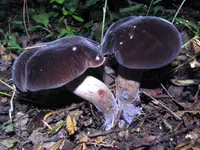
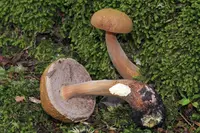
Black velvet bolete, Tylopilus alboater, is a mycorrhizal fungus that forms symbiotic relationships with tree roots, not a typical houseplant. It produces thick, fleshy caps with a dark, velvety surface and a stout, pale stem, usually appearing in summer and fall. This species is native to eastern North America, where it grows in forests, often with oaks and other hardwoods. It is considered uncommon and depends on healthy woodland habitat, which makes it difficult to cultivate deliberately, so most people interested in how to care for Black Velvet Bolete focus on protecting suitable forest conditions rather than growing it indoors or in gardens.

Care Difficulty
Hard Care

Light Preference
Partial Shade

Water Requirements
Keep Soil Moist

Temperature Preference
Cool Climate

Hardiness Zone
Unknown

Soil Texture
Loamy, Silty, Organic-rich

Soil pH
Strongly acidic (4.5–5.5), Acidic (5.5–6.5)

Soil Drainage
Moist but well-drained

Fertilization
Minimal (feed rarely)
Scan your plant to receive care tips personalized for your specific plant
Available on iOS and Android
This ectomycorrhizal mushroom prefers woodland light conditions rather than open-field sun.
This species depends on naturally moist, well-drained forest soil rather than direct watering.
This woodland fungus fruits best in mild to warm conditions typical of late spring to early fall in temperate climates.
Humidity is not a key factor for Tylopilus alboater, which naturally grows in outdoor forest conditions.
This ectomycorrhizal fungus requires specific forest-like soil conditions and cannot be sustained in standard garden or potting mixes.
This species is not suitable for container growing, as it depends on long-term mycorrhizal association with living tree roots in stable forest soil.
This ectomycorrhizal fungus relies on its host tree for nutrition, so direct fertilization is usually unnecessary for Tylopilus alboater or Black Velvet Bolete.
Pruning does not apply to Tylopilus alboater, since the visible part is a mushroom fruiting body, not a woody or leafy plant structure.
Transplanting focuses on the host tree and soil environment rather than the fungus itself, since Tylopilus alboater forms a root partnership underground.
Propagation of Tylopilus alboater is specialized and not practical for typical home growers, because it depends on a complex mycorrhizal relationship with compatible trees.
No special winter care is needed for Tylopilus alboater in its natural range, as the underground mycelium is cold hardy and survives normal freezes.

Plant Health Check
Not sure what's wrong with your plant? Check your plant's health inside the app.
Mature fruiting bodies develop a pore surface that shifts from pale to a distinctive sooty gray to black, which is unusual among North American boletes and helps distinguish it from many similar species with yellow or olive pores.
The flesh is technically edible but has a strongly bitter taste, especially in the pore layer and cap cuticle, so some foragers discard these parts or avoid the species altogether despite its lack of known toxins.
This bolete forms ectomycorrhizal associations with oaks in eastern North America, exchanging mineral nutrients and water for sugars from the tree and typically fruiting in mixed or hardwood forests where oaks are dominant.

When sliced and exposed to air, the firm white flesh often shows little to no color change compared with many related boletes that rapidly bruise blue, making its mostly non-staining flesh a useful field character for confirming identification.
This species is considered edible for most people but has a distinctly bitter taste that many find unpleasant. Correct identification is critical, as some similar boletes cause gastrointestinal upset. Avoid any specimen that tastes strongly bitter or shows signs of decay.
Keep your plants happy and healthy with plant identification, disease detection, and easy care guidance.