Staggered Succession Sowing
Sow small batches every 2–3 weeks in late spring and early summer so flowering spikes mature at different times, extending both garden display and harvest window.

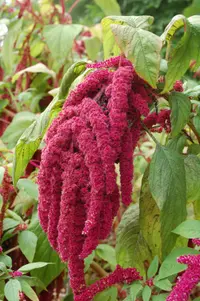
Love-lies-bleeding (Amaranthus caudatus) is a fast-growing annual flowering plant known for its long, trailing tassels of deep red or magenta flowers. It forms an upright, branching plant with broad leaves and hanging inflorescences that can give a dramatic, cascading effect in borders or containers.
This species is native to parts of South America but is now grown in many warm and temperate regions as an ornamental and sometimes as a grain or leafy vegetable. It is generally easy to grow from seed, with rapid growth and good tolerance of heat and poor soils. A sunny position and moderately moist, well-drained soil are usually enough to care for love-lies-bleeding.

Care Difficulty
Easy Care

Light Preference
Full Sun

Water Requirements
Regular Water

Temperature Preference
Tropical / Frost Sensitive

Hardiness Zone
2–11

Soil Texture
Sandy, Loamy, Organic-rich

Soil pH
Acidic (5.5–6.5), Slightly acidic (6.5–7.0)

Soil Drainage
Moist but well-drained

Fertilization
Moderate (every 2–4 weeks)
Scan your plant to receive care tips personalized for your specific plant
Available on iOS and Android
Amaranthus caudatus thrives in strong sunlight for dense foliage and long flower tassels.
Amaranthus caudatus prefers consistently moist but not saturated soil during active growth.
This warm-season annual grows best in stable, frost-free conditions.
Humidity is rarely a limiting factor for love-lies-bleeding in typical outdoor conditions.
Amaranthus caudatus prefers loose, well-drained, moderately fertile soil to support fast growth.
This species can grow well in large outdoor containers if given enough root space and stability.
This annual benefits from modest feeding to support strong growth and flowering in love-lies-bleeding.
Pruning Amaranthus caudatus is mainly used to manage size, encourage branching, and keep plants tidy.
This annual is usually transplanted outdoors rather than repotted, since it completes its life cycle in one season.
This species is most commonly propagated from seed, which germinates quickly under warm conditions.
Amaranthus caudatus is a frost-sensitive annual and does not survive true winter outdoors in most climates.

Plant Health Check
Not sure what's wrong with your plant? Check your plant's health inside the app.
This species was domesticated in the Andean region thousands of years ago as a grain crop, and its tiny seeds are still used there in traditional foods and rituals.
The long, drooping red tassels are compound inflorescences made of many densely packed flowers, each capable of producing numerous small seeds that give the plant very high reproductive output.
Its deep red color comes from betalain pigments rather than anthocyanins, a trait typical of the amaranth family and useful in studying plant pigment evolution.

In parts of the Andes, this species has been culturally significant enough to be grown around dwellings and ceremonial areas, where the long crimson tassels were historically used as symbolic adornments in festivals and religious observances.
Yes, this species is edible. Young leaves can be cooked like spinach, and the seeds are used as a grain. Only consume plants grown without pesticides and avoid roadside or contaminated sites to limit heavy metal exposure.
Keep your plants happy and healthy with plant identification, disease detection, and easy care guidance.