


Early growth control
Install sturdy root barriers and regularly cut back young runners at the edges of the planting area to prevent the vine from colonizing unintended spaces.

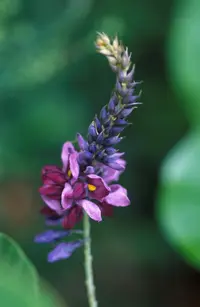
Kudzu, Pueraria montana, is a fast-growing perennial vine known for its vigorous climbing and dense foliage. It produces trifoliate leaves and can form thick, green curtains over trees, fences, and structures.
This species is native to East Asia but is now widespread in the southeastern United States, where it often grows in disturbed or open areas. It establishes easily in warm climates, especially where winters are mild.
Kudzu is generally easy to grow because of its rapid growth rate, strong roots, and tolerance of poor soils. It prefers full sun, consistent moisture, and well-drained soil, but adapts readily, which makes it important to understand how to care for kudzu responsibly.

Care Difficulty
Easy Care

Light Preference
Full Sun

Water Requirements
Moderate Water

Temperature Preference
Cold Hardy

Hardiness Zone
5–10

Soil Texture
Sandy, Loamy, Clay

Soil pH
Acidic (5.5–6.5), Slightly acidic (6.5–7.0)

Soil Drainage
Well-drained

Fertilization
Minimal (feed rarely)
Scan your plant to receive care tips personalized for your specific plant
Available on iOS and Android
Pueraria montana grows fastest in full sun but tolerates some light shade, especially in hot climates.
This vigorous vine prefers consistently moist, well-drained soil once established in the landscape.
This species is a hardy, fast-growing perennial vine adapted to a wide outdoor temperature range.
This vine handles a wide humidity range but prefers moderate moisture in the air.
Pueraria montana thrives in loose, well-aerated soil that drains freely but does not dry out instantly.
This species can be grown in containers but demands careful management due to vigorous roots and vines.
Pueraria montana grows vigorously and usually needs only light feeding on poor soils.
Pruning Pueraria montana is important to limit spread and maintain a manageable framework.
This vigorous vine is usually grown in the ground, so care focuses on safe transplanting rather than routine repotting.
Pueraria montana is commonly propagated, but spreading it should be considered very carefully due to its invasive potential.
This species is generally cold hardy in much of its range and needs little winter care once established.

Plant Health Check
Not sure what's wrong with your plant? Check your plant's health inside the app.
This species forms root nodules that host Rhizobium bacteria, which convert atmospheric nitrogen into forms the plant can use, allowing it to grow vigorously on very poor soils.
Individual vines can extend several meters in a single growing season, and new plants readily form where nodes touch the soil and root, creating dense, layered mats of stems and leaves.
Its large, trifoliate leaves overlap to form thick canopies that significantly reduce light reaching other plants, which helps explain its strong competitive ability in invaded habitats.

In the southeastern United States, this species was intentionally promoted and planted in the early–mid 20th century for erosion control and forage, and was later reclassified as a noxious invasive weed after its aggressive spread transformed many landscapes.
This species is one of the fastest-growing vines, often extending 30–60 cm per day in warm, humid seasons and several meters per year. Growth slows in poor soil, shade, cool weather, or with regular cutting.
Keep your plants happy and healthy with plant identification, disease detection, and easy care guidance.


honey mushroom
Armillaria ostoyae

White Variegated Monstera
Monstera deliciosa 'Albovariegata'

Ageratina glabrata
Ageratina glabrata
gale of the wind
Phyllanthus niruri

Monstera deliciosa 'Thai Constellation'
Monstera deliciosa 'Thai Constellation'

turkey tangle fogfruit
Phyla nodiflora

springtime amanita
Amanita velosa
 POPULAR
Taro
Colocasia esculenta