Succession Seedings
Stagger sowing every 2–3 weeks in early spring so that as first-year rosettes bolt and fade, younger plants are ready to take over and extend the flowering display.

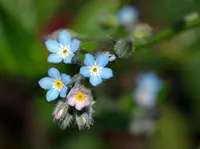
Wood forget-me-not (Myosotis sylvatica) is a small, short-lived perennial often grown as a biennial, valued for its soft mounds of foliage and masses of tiny blue flowers. The blooms usually have yellow or white centers and form loose clusters that sit above the leaves, creating a delicate haze of color in spring.
In nature it grows in woodlands, stream banks, and moist meadows across parts of Europe and western Asia, and it has naturalized in many temperate regions. It prefers cool conditions, partial shade, and evenly moist, well-drained soil, which makes it relatively simple to care for wood forget-me-not in many gardens.

Care Difficulty
Easy Care

Light Preference
Partial Shade

Water Requirements
Keep Soil Moist

Temperature Preference
Cool Climate

Hardiness Zone
3–8

Soil Texture
Loamy, Silty, Organic-rich

Soil pH
Acidic (5.5–6.5), Slightly acidic (6.5–7.0)

Soil Drainage
Moist but well-drained

Fertilization
Minimal (feed rarely)
Scan your plant to receive care tips personalized for your specific plant
Available on iOS and Android
This woodland biennial prefers cool, soft light rather than intense sun.
This species prefers consistently moist but not waterlogged soil.
This cool-season plant grows best in mild conditions and dislikes intense heat.
This species prefers cool, moderately moist air but usually adapts to typical outdoor humidity levels.
This plant grows best in consistently moist, cool, well-aerated soil.
This species is suitable for short-term container displays, especially in cool seasons.
Myosotis sylvatica is a light feeder that benefits from modest nutrition in poor soils or containers.
Pruning Myosotis sylvatica is mainly used to tidy plants and extend flowering.
This species is usually treated as a short-lived bedding or biennial plant, so transplanting is more common than repotting.
Myosotis sylvatica is most often renewed by seed, which the plant readily produces and self-sows.
Myosotis sylvatica is generally cold hardy in temperate climates and needs minimal winter care in the ground.

Plant Health Check
Not sure what's wrong with your plant? Check your plant's health inside the app.
This species is naturally adapted to cool, moist European woodlands and often flowers in early spring before trees fully leaf out, taking advantage of higher light at the forest floor.
The flowers show a stable sky-blue color in most garden forms due to the presence of delphinidin-based anthocyanin pigments, which are relatively rare among common garden bedding plants.
Although each plant is typically biennial or short-lived perennial, it readily self-seeds in suitable conditions, forming persistent colonies that appear year after year without replanting.

The five yellow-tinted throat scales of each flower act as nectar guides, visually directing pollinators such as small bees and hoverflies toward the nectar source and improving the plant’s pollination efficiency in its woodland habitats.
This species self-seeds freely and can form dense patches over several seasons, especially in cool, moist climates. Deadheading before seed set and lifting unwanted seedlings each spring keeps it from spreading more than desired.
Keep your plants happy and healthy with plant identification, disease detection, and easy care guidance.