


Use capillary mats
Place the moss container on a capillary mat kept evenly moist so the substrate rehydrates from below without disturbing the delicate shoots.

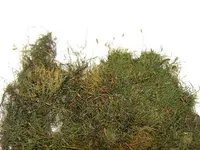
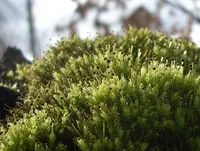
Creeping feather moss (Amblystegium serpens) is a low, mat-forming moss that spreads in thin, feathery carpets over soil, rocks, and decaying wood. It stays small and fine-textured, creating a soft green cover rather than tall clumps.
In nature it is widespread across temperate regions, commonly found in woodlands, shaded lawns, stream banks, and damp walls. It tolerates some disturbance and adapts to a range of moisture levels, which makes it relatively forgiving.
This moss prefers consistent moisture, shade to dappled light, and stable, undisturbed surfaces. These traits make it suitable for terrariums, bonsai plantings, and shaded outdoor areas, especially if the owner wants to learn how to care for Creeping Feather Moss without complex maintenance demands.

Care Difficulty
Moderate Care

Light Preference
Partial Shade

Water Requirements
Keep Soil Moist

Temperature Preference
Cold Hardy

Hardiness Zone
3–9

Soil Texture
Loamy, Silty, Organic-rich

Soil pH
Strongly acidic (4.5–5.5), Acidic (5.5–6.5)

Soil Drainage
Waterlogged tolerant

Fertilization
Minimal (feed rarely)
Scan your plant to receive care tips personalized for your specific plant
Available on iOS and Android
This moss prefers low to moderate light that mimics a shaded forest floor.
This moss needs consistently moist conditions but suffers in standing water.
This moss favors cool to mild temperatures and tolerates moderate cold.
This moss needs consistently high humidity to stay dense and green.
This moss prefers a consistently moist, fine-textured, organic substrate rather than conventional potting soil.
This species adapts well to shallow containers, trays, and terrariums.
Amblystegium serpens, or creeping feather moss, has very low nutrient needs and usually thrives without added fertilizer in most settings.
Amblystegium serpens needs only light grooming to maintain an even, healthy carpet of moss.
This moss is usually transplanted rather than repotted, since it forms shallow mats rather than deep root systems.
Propagation of Amblystegium serpens is straightforward through division and replanting of small mat sections.
This moss is quite cold hardy and usually needs minimal winter attention in the ground or on outdoor hardscape.

Plant Health Check
Not sure what's wrong with your plant? Check your plant's health inside the app.
This moss commonly establishes on man-made substrates such as brick walls, concrete, roof tiles, and old mortar, making it one of the more frequent bryophytes in towns and cities across Europe and North America.
It forms loose creeping mats that can grow both on soil and as an epiphyte on tree bases, logs, and stones, showing high ecological plasticity compared with many more substrate-specific mosses.
Its slender, irregularly branched stems, usually only 1–4 cm long, can rapidly spread across damp surfaces, helping it quickly occupy new microhabitats after disturbance.

This species often reproduces mainly through abundant spores released from its small, curved capsules, allowing it to colonize new urban and rural sites over considerable distances via wind dispersal.
Growth is moderate under consistently moist, cool conditions. It usually spreads a few centimeters per year, forming a thin mat rather than gaining height. Growth slows in heat or drought and resumes when moisture and temperatures become favorable again.
Keep your plants happy and healthy with plant identification, disease detection, and easy care guidance.

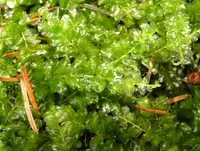
Many-fruited Thyme-moss
Plagiomnium affine
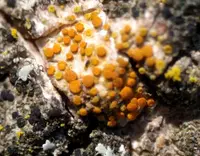
Athallia cerinella
Athallia cerinella
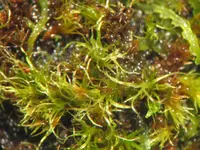
campylopus moss
Campylopus pyriformis
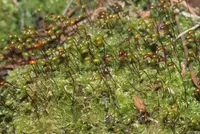
velvet feather-moss
Brachytheciastrum velutinum
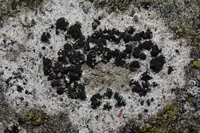
Arthonia calcarea
Arthonia calcarea
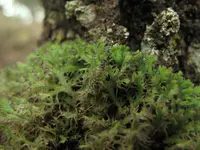
Great Ciliated Lichen
Anaptychia ciliaris
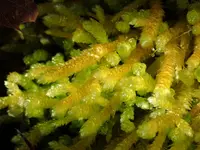
bryoandersonia moss
Bryoandersonia illecebra
aulacomnium moss
Aulacomnium androgynum