Support Heavy Petiole
Install a sturdy stake or short plant support when the main leaf stalk reaches 30–40 cm to prevent wind or accidental knocks from snapping the heavy petiole near the corm.

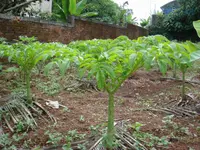
Elephant foot yam, Amorphophallus paeoniifolius, is a tropical tuber-forming plant grown for its large underground corm and bold, dramatic foliage. It produces a single umbrella-like leaf on a thick mottled stalk each season, then dies back to the corm during dormancy. In nature it occurs in South and Southeast Asia, often in warm, humid, monsoon-influenced regions and light shade. The plant is relatively easy to manage if its strong seasonal cycle and need for well-drained, fertile soil are understood. Gardeners who learn how to care for Elephant Foot Yam usually find it straightforward in warm climates or protected containers.

Care Difficulty
Moderate Care

Light Preference
Partial Shade

Water Requirements
Regular Water

Temperature Preference
Tropical / Frost Sensitive

Hardiness Zone
10–11

Soil Texture
Loamy, Sandy, Organic-rich

Soil pH
Acidic (5.5–6.5), Slightly acidic (6.5–7.0)

Soil Drainage
Moist but well-drained

Fertilization
Moderate (every 2–4 weeks)
Scan your plant to receive care tips personalized for your specific plant
Available on iOS and Android
This species prefers bright, indirect light and protection from harsh midday sun for strongest growth.
This tuberous plant prefers steadily moist but never waterlogged soil during its active growing season.
This tropical species thrives in consistently warm, frost-free conditions for reliable growth and corm development.
This species prefers moderately humid air but usually tolerates typical indoor levels if other conditions are stable.
This aroid grows best in loose, organic-rich, free-draining soil that still holds some moisture around the tuber.
This species is suitable for container growing when the pot is chosen to support its large, underground tuber and tall seasonal leaf.
Nutrient-rich soil supports vigorous leaf and corm growth in Elephant Foot Yam during its active season.
Pruning needs for Amorphophallus paeoniifolius are minimal and focus mainly on hygiene.
Container-grown plants and crowded clumps benefit from occasional transplanting to support corm enlargement.
New Amorphophallus paeoniifolius plants are most often produced by dividing corms or using offsets.
This tropical species is sensitive to frost and needs careful winter handling in cooler regions.

Plant Health Check
Not sure what's wrong with your plant? Check your plant's health inside the app.
The underground corm of this species is widely eaten as a starchy vegetable in parts of South and Southeast Asia and has been traditionally used as an emergency or famine food due to its reliable yield in poor soils.
Each year the plant sends up a single huge, umbrella-like leaf from the corm that can resemble a small tree, then dies back completely to the underground storage organ during its dry-season dormancy.
When in bloom, the large, hooded inflorescence emits a strong odor similar to rotting material, which attracts carrion-loving insects that act as pollinators.

In some regions of India and Southeast Asia, farmers have selected and named local cultivars of this species for reduced acridity and better flavor, and it is grown as a field crop in rotation with staples like rice and taro.
This aroid usually needs to reach a substantial tuber size and store enough energy before flowering. Cool, dry rest during dormancy is critical. It often skips flowering some years and prioritizes building the underground tuber instead.
Keep your plants happy and healthy with plant identification, disease detection, and easy care guidance.