East Asian peppervine Care (Ampelopsis japonica)

East Asian peppervine

About East Asian peppervine

East Asian peppervine (Ampelopsis japonica) is a deciduous climbing vine grown mainly for its foliage and small, decorative berries. It uses tendrils to attach to supports and can form a dense, layered screen when given space.

In the wild, it occurs in parts of East Asia, often in forest edges and thickets. Its growth is vigorous in mild climates, which can make it robust but also somewhat spreading.

The plant prefers moderate light, regular moisture, and well-drained soil, which makes it adaptable in many gardens. With its fast growth and tolerance of a range of conditions, learning how to care for East Asian peppervine is straightforward for most home gardeners.

Main Plant Requirements

Care Difficulty

Moderate Care

Light Preference

Partial Shade

Water Requirements

Moderate Water

Temperature Preference

Cold Hardy

Hardiness Zone

5–9

Soil Texture

Loamy, Sandy, Organic-rich

Soil pH

Acidic (5.5–6.5), Slightly acidic (6.5–7.0)

Soil Drainage

Moist but well-drained

Fertilization

Minimal (feed rarely)

Get Personalized Care Plan

Scan your plant to receive care tips personalized for your specific plant

Available on iOS and Android

How to Care for the East Asian peppervine

This climbing vine grows best with bright, indirect light and some gentle direct sun each day.

  • Provide 3–5 hours of morning sun with light afternoon shade; an east or light north exposure suits East Asian peppervine well outdoors.
  • Tolerates partial shade but dense shade leads to weak, stretched shoots and sparse foliage; aim for dappled light under taller plants or structures.
  • In hot summers, protect from strong midday sun to prevent leaf scorch; in winter, maximize exposure by avoiding deep shade from buildings or evergreen trees.

This species prefers evenly moist, well-drained soil that never stays waterlogged for long periods.

  • Before watering, check that the top 3–5 cm of soil feel dry; then water thoroughly so moisture reaches the deeper root zone.
  • During active growth in spring and summer, dryness of leaves, limp tips, and very light soil indicate underwatering; adjust frequency in heat waves.
  • In autumn and winter, reduce watering as growth slows, but avoid soggy soil that causes yellowing leaves, soft stems, or fungal smells around Ampelopsis japonica roots.

This hardy climber tolerates a wide range of outdoor temperatures but grows fastest in mild conditions.

  • Optimal growing temperatures are around 65–80°F (18–27°C), supporting steady shoot and leaf development during the main growing season.
  • Mature plants tolerate winter lows near 5–10°F (-15 to -12°C) once established, but young vines benefit from mulch to protect roots from deep freezes.
  • In hot regions, brief periods up to 90–95°F (32–35°C) are tolerated if soil moisture is maintained; prolonged heat with drought can stunt growth and scorch foliage.

This species manages well in typical indoor humidity but benefits from slightly moist air in heated homes.

  • Aim for 40–60% relative humidity for East Asian peppervine to reduce leaf edge browning and drop.
  • It tolerates short periods of drier air, but prolonged humidity below 30% may cause curled, crispy leaves.
  • Increase humidity locally with a pebble tray or grouping plants rather than misting, which has only short-lived effects.

Ampelopsis japonica prefers loose, moderately fertile, well-drained soil that still holds some moisture.

  • Use a loamy, organic-rich mix such as 2 parts all-purpose potting mix, 1 part compost, and 1 part perlite or coarse sand.
  • Ensure free drainage so water passes through quickly yet the mix stays slightly moist rather than waterlogged.
  • Target a slightly acidic to neutral pH of about 6.0–7.0, which supports balanced nutrient availability.
  • Avoid heavy clay, compacted substrates, or peat-only mixes that either stay soggy or collapse and reduce aeration.

This species adapts well to container growing when the pot supports its vining, sometimes top-heavy habit.

  • Choose a wide, weighty container to counterbalance climbing growth and reduce the risk of tipping in wind.
  • Provide a trellis or support fixed firmly in the pot so stems do not pull and loosen the root ball as they elongate.
  • Select a pot material with moderate moisture retention, such as glazed ceramic, to keep the root zone evenly moist without rapid drying.

This vigorous vine benefits from moderate feeding during the active growing season to support leafy growth and berry production.

  • Use a balanced NPK liquid fertilizer at half strength every 4–6 weeks from spring to late summer for Ampelopsis japonica.
  • Alternatively, top-dress with a thin layer of mature compost in spring to improve soil structure and slow nutrient release.
  • In containers, consider a slow-release fertilizer in spring, following label rates for vining plants.
  • Stop feeding in fall and winter, when growth slows, to avoid weak, overly soft shoots.

Thoughtful pruning keeps Ampelopsis japonica controlled, healthy, and structurally sound.

  • Plan main pruning for late winter or very early spring, before strong new growth begins.
  • Remove dead, diseased, or damaged stems first, then thin crowded or crossing shoots to improve air flow.
  • Shorten overly long vines to guide the plant along its support and prevent it from smothering nearby plants.
  • Use clean, sharp bypass pruners and make angled cuts just above a healthy bud or side shoot.

This vine is more often planted in the ground than kept in containers, so focus on careful site transplanting.

  • Transplant in early spring or early fall, when temperatures are mild and the plant is not under heat stress.
  • Look for slow growth, roots circling the pot, or frequent wilting as signs a container-grown plant needs a larger space.
  • Move into a hole or pot 1–2 sizes larger, using well-drained soil and spreading roots gently outward.
  • Water thoroughly after planting, then keep soil evenly moist and shaded for 1–2 weeks to reduce transplant shock.

Ampelopsis japonica is commonly propagated by softwood cuttings and layering, with seeds also possible.

  • Take 8–10 cm softwood cuttings in late spring to early summer, cutting below a node and removing lower leaves.
  • Insert cuttings into moist, sterile medium under high humidity and bright, indirect light to encourage rooting.
  • Use simple layering by pegging a flexible stem to the soil, covering a section, and severing once roots form.
  • Sow cleaned seeds in fall or after cold stratification, keeping the mix evenly moist until germination.

This vine is moderately cold hardy but benefits from light winter protection in colder regions.

  • Once dormant, it tolerates light to moderate frost, though very harsh freezes can damage young stems.
  • Apply a 5–8 cm mulch layer around the root zone in late fall to buffer temperature swings.
  • In cold climates, grow Ampelopsis japonica in containers and move them into an unheated, frost-free shelter for winter.
  • Avoid heavy winter watering; keep soil barely moist to prevent root rot while the plant is dormant.

Care Tips

Provide climbing structure

Install a sturdy trellis, wire mesh, or tensioned garden wire early, then gently tie new shoots with soft ties so the vine establishes a clear framework and does not tangle or smother nearby plants.

Root zone containment

In open ground, use a root barrier or plant in a large, heavy container sunk partly into the soil to limit spread and make long‑term management easier, especially in mild climates where it can become invasive.

Regular shoot thinning

Once or twice a year, selectively remove congested, crossing, or inward‑growing shoots to keep good air flow through the plant and reduce the risk of foliar diseases such as powdery mildew.

Targeted pest monitoring

Check the undersides of leaves and soft new growth every 1–2 weeks during warm weather for aphids, spider mites, and scale, and treat early with a directed spray of water or a labeled horticultural soap if colonies appear.

Seasonal hardening outdoors

When moving container plants from indoors or a sheltered spot outside, harden them off over 7–10 days by gradually increasing light and wind exposure to prevent leaf scorch and stress while growing East Asian peppervine.

Common Pests and Diseases

Grape phylloxera

This pest feeds on roots and sometimes leaves, causing galls, yellowing, and reduced vigor in Ampelopsis and related grape family vines. Symptoms include stunted growth and general decline, especially in poorly drained or compacted soils.

Solution

Remove and destroy heavily galled leaves and thin congested growth to improve air and light penetration. For persistent infestations, use a systemic insecticide labeled for phylloxera on ornamental grapes and related vines, and improve soil structure and drainage to reduce plant stress and support recovery when growing East Asian peppervine outdoors or in large containers.

Grape leafhopper

These insects suck sap from the underside of leaves, leading to pale stippling, leaf yellowing, and premature leaf drop. This pest is favored by hot, dry conditions and dense, unpruned vines where leaves stay crowded.

Solution

Rinse foliage thoroughly with a strong stream of water, focusing on leaf undersides, and remove heavily damaged leaves to limit population buildup. Encourage natural predators such as lacewings and lady beetles, and if needed apply an insecticidal soap or light horticultural oil in the early morning, repeating as directed until new growth appears clean.

Powdery mildew

This disease appears as white, powdery patches on leaves, young stems, and sometimes fruit, which can lead to leaf curling and reduced vigor. Symptoms include distorted new growth and leaves that may yellow and drop early if the infection is heavy.

Solution

Prune to increase airflow through the vine, remove and discard infected leaves, and avoid overhead watering so foliage dries quickly. Apply a labeled fungicide for powdery mildew on ornamental vines or use a sulfur or potassium bicarbonate product preventively during warm, humid periods, following label directions closely.

Anthracnose leaf spot

This disease produces brown or tan spots with darker margins on leaves and sometimes lesions on stems, which can merge into larger dead areas. Symptoms include tattered foliage, premature leaf drop, and a generally thin canopy on affected vines.

Solution

Cut out and dispose of infected leaves and any canes with obvious lesions, and keep the area under the plant free of fallen debris to reduce reinfection. Improve air circulation with selective pruning and, in wet seasons or repeated outbreaks, use a labeled broad-spectrum fungicide on new growth at the first sign of spotting.

Grape berry moth

This pest targets developing berries, where larvae tunnel and feed, causing webbing, discoloration, and premature fruit drop. Symptoms include frass (insect droppings) on fruit clusters and shriveled or misshapen berries on ornamental Ampelopsis with showy fruit.

Solution

Prune and destroy infested fruit clusters as soon as damage is noticed, and clean up all fallen berries to break the life cycle. In areas with recurring problems, consider pheromone traps to monitor adult moth activity and use a targeted biological insecticide containing Bacillus thuringiensis (Bt) on young larvae, timing sprays according to local moth emergence patterns.

Interesting Facts

Climbing with tendrils

This species uses forked tendrils that arise opposite its leaves to hook onto supports, allowing the vine to climb and form dense vertical sheets over shrubs and small trees.

Distinctive spotted berries

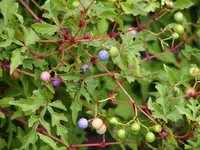
Its small spherical berries often show speckled or mottled surfaces as they mature, a feature that helps distinguish it from some related grape-family vines in the field.

Native East Asian range

The vine is native to East Asia, especially Japan, Korea, and parts of China, where it naturally grows in forest margins, thickets, and disturbed sites with moderate light.

FAQs about East Asian peppervine

This species can spread quickly by vigorous stems and self-seeding in mild climates. In favorable conditions it may become weedy, so use root barriers, regular pruning, and monitor nearby beds for unwanted seedlings.

Grow Healthy Plants with Botan Care

Keep your plants happy and healthy with plant identification, disease detection, and easy care guidance.

Botan plant care app — identify plants on mobile

Explore More Plants