Robust climbing support
Install a strong trellis, wire mesh, or tensioned cables rated to hold significant weight before planting, as mature vines and pods are heavy and can deform or collapse weak structures.

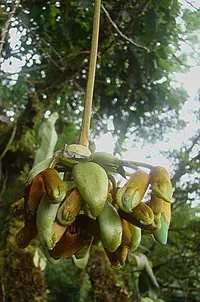
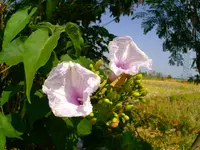
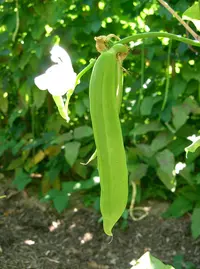
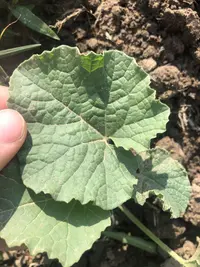
Oxeye bean, Mucuna urens, is a vigorous tropical climbing vine known for its long, hanging pods and large, glossy green leaves. It can quickly cover supports, fences, or trees in suitable climates. Native to tropical regions of the Americas and Africa, it prefers warm conditions and does not tolerate frost. The plant is robust but needs strong support and space, which can make care for oxeye bean challenging in small gardens. It generally favors bright light, consistent moisture, and well-drained soil, performing best in stable, warm outdoor environments rather than compact indoor settings.

Care Difficulty
Moderate Care

Light Preference
Partial Shade

Water Requirements
Regular Water

Temperature Preference
Tropical / Frost Sensitive

Hardiness Zone
10–12

Soil Texture
Sandy, Loamy, Organic-rich

Soil pH
Acidic (5.5–6.5), Slightly acidic (6.5–7.0)

Soil Drainage
Moist but well-drained

Fertilization
Minimal (feed rarely)
Scan your plant to receive care tips personalized for your specific plant
Available on iOS and Android
Mucuna urens prefers bright, warm conditions similar to its native tropical habitat.
This vigorous climber needs steady moisture but poorly drained soil quickly causes root problems.
This tropical vine thrives in consistently warm, frost‑free conditions.
This vigorous tropical vine prefers moderately humid air but usually adapts to typical household levels if watering is consistent.
Mucuna urens prefers deep, loose, well-drained soil that still holds some moisture and organic matter.
This large, fast-growing climber is only moderately suitable for containers and needs a carefully chosen setup when grown this way.
This vigorous tropical vine benefits from moderate feeding during active growth but does not need heavy fertilization.
Pruning Mucuna urens helps control its vigorous growth and maintain a manageable framework.
This large, fast-growing liana is more often transplanted outdoors than kept long term in containers.
Mucuna urens is most commonly propagated from seed under warm, moist conditions.
This species is frost-sensitive and needs protection in regions with cool or freezing winters.

Plant Health Check
Not sure what's wrong with your plant? Check your plant's health inside the app.
The pods are hard, woody, and covered with dense, stiff hairs that can easily irritate skin and cling to animal fur, helping the seeds disperse through forests.
This species grows as a robust woody vine in tropical forests, using surrounding trees as support to reach the upper canopy and access stronger light.
As a member of the legume family, it forms root nodules with symbiotic bacteria that convert atmospheric nitrogen into forms usable by plants, enriching nutrient-poor tropical soils.

The seeds of this species are buoyant and very hard-shelled, allowing them to survive long periods in water and disperse along rivers and coastal currents before germinating on new shorelines.
This species is a vigorous twining vine that climbs by wrapping its stems around nearby supports such as trees, trellises, or fences. Without vertical structures, it will scramble over nearby vegetation rather than form a neat ground cover.
Keep your plants happy and healthy with plant identification, disease detection, and easy care guidance.