Monitor substrate fouling
Inspect the culture surface regularly for accumulating detritus or biofilm and gently siphon or rinse it away to maintain good gas exchange around the thallus and prevent localized rot when caring for cratered duster.

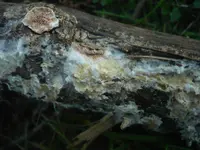
Amphinema byssoides, sometimes called cratered duster, is not a typical houseplant but a small basidiomycete fungus found in cool, moist forest habitats. It usually appears as delicate, whitish to cream, cobweb-like growth on decaying wood or roots, rather than as a leafy plant.
This species occurs mainly in temperate regions of the Northern Hemisphere, often associated with coniferous trees in damp, shaded sites. Its specialized habitat and subtle appearance make it difficult to cultivate, so most people only encounter it in the wild rather than trying to care for cratered duster indoors.

Care Difficulty
Moderate Care

Light Preference
Partial Shade

Water Requirements
Moderate Water

Temperature Preference
Warm Climate

Hardiness Zone
Unknown

Soil Texture
Loamy

Soil pH
Slightly acidic (6.5–7.0)

Soil Drainage
Well-drained

Fertilization
Minimal (feed rarely)
Scan your plant to receive care tips personalized for your specific plant
Available on iOS and Android
This guide outlines the sunlight needs of Amphinema byssoides, sometimes called cratered duster, in simple, practical terms.
Amphinema byssoides requires consistently moist conditions without prolonged flooding or complete drying.
Stable, cool to mildly warm temperatures support healthy development of this species.
This species has modest humidity needs but reacts poorly to very dry air over time.
This fungus-like marine organism is not grown in soil in typical horticultural settings.
This species is not suitable for container growing under normal home or garden conditions.
Amphinema byssoides, sometimes called cratered duster, is usually not fertilized in natural or restoration settings and performs well in low-nutrient conditions.
Amphinema byssoides needs only minimal pruning, mainly to maintain plant health and access.
Transplanting Amphinema byssoides is infrequent and mainly done when establishing or relocating clumps in the landscape.
Propagation of Amphinema byssoides is usually carried out by specialists and is not common for casual gardeners.
Amphinema byssoides is generally cold hardy in suitable climates and needs little specific winter care once established.

Plant Health Check
Not sure what's wrong with your plant? Check your plant's health inside the app.
This marine hydrozoan forms tiny jellyfish-like medusae only a few millimeters across, with a delicate, almost transparent body that makes it difficult to detect in the water column.
It is typically found in cold, northern marine waters of the North Atlantic and adjacent Arctic-influenced seas, where it is part of the plankton community in seasonally productive coastal zones.
Like many hydrozoans, it has a life cycle that includes both a bottom-dwelling polyp stage and a free-swimming medusa stage, allowing it to exploit both benthic (seafloor) and pelagic (open water) habitats.
Growth is generally slow to moderate. In suitable conditions, this species increases its biomass gradually over several seasons rather than rapidly filling space. Consistent moisture, stable temperatures, and low physical disturbance support the best growth rate when trying to grow Amphinema byssoides.
Keep your plants happy and healthy with plant identification, disease detection, and easy care guidance.