Host tree pairing
Plant mycelium or spawn near compatible pine species, such as lodgepole or shore pine, since this fungus relies on forming ectomycorrhizal partnerships with living conifer roots to fruit reliably.

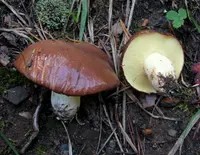
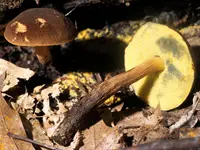
Short-stalked Suillus (Suillus brevipes) is a fleshy, mycorrhizal fungus, not a leafy plant. It forms low, stout mushrooms with smooth brown caps and very short stems. These mushrooms grow naturally in pine forests, especially in western North America, often appearing in large, scattered groups on the ground. Suillus brevipes relies on living pine roots, so it does not adapt well to typical indoor or container culture. For those who want to learn how to care for Short-stalked Suillus in a managed woodland or restoration setting, conditions must closely mimic a healthy conifer forest with suitable soil moisture and host trees.

Care Difficulty
Moderate Care

Light Preference
Partial Shade

Water Requirements
Regular Water

Temperature Preference
Cold Hardy

Hardiness Zone
4–9

Soil Texture
Sandy, Loamy, Organic-rich

Soil pH
Acidic (5.5–6.5)

Soil Drainage
Moist but well-drained

Fertilization
Minimal (feed rarely)
Scan your plant to receive care tips personalized for your specific plant
Available on iOS and Android
This ectomycorrhizal mushroom prefers bright woodland conditions with filtered light rather than open, exposed sun.
Suillus brevipes relies on consistently moist, not waterlogged, soil around its conifer hosts to support healthy mycelium and fruiting.
This species performs best in cool to mild conditions typical of coniferous forests, with clear limits to both heat and frost tolerance.
Humidity is not a significant factor for Suillus brevipes, which is adapted to open, dryish forest conditions.
Suillus brevipes fruits best in light, well-aerated soil that mimics its natural pine forest habitat.
This species is generally unsuitable for container growing because it depends on ectomycorrhizal association with living conifer roots in open soil.
Suillus brevipes forms mycorrhizal partnerships with conifers and usually needs no additional fertilizer in natural or woodland-style plantings.
Suillus brevipes is a wild mycorrhizal fungus, not a landscape shrub, so intentional pruning is not part of its management.
Short-stalked Suillus is rarely grown in containers, so management focuses on suitable transplanting of host trees rather than the fungus itself.
Suillus brevipes spreads mainly through spores and natural mycelium growth, so deliberate propagation at home is uncommon and technically demanding.
This fungus is naturally cold hardy with its conifer hosts and needs no special winter care in typical outdoor conditions within its range.

Plant Health Check
Not sure what's wrong with your plant? Check your plant's health inside the app.
This species forms a highly specific ectomycorrhizal partnership with several 2-needle pines, particularly lodgepole pine, trading mineral nutrients and water from the soil for sugars produced by the tree.
The mushroom has a characteristically short, stocky stipe compared to related Suillus species, which is a key field trait used by mycologists to separate it from similar pine-associated boletes.
It often appears abundantly in conifer forests that have experienced recent disturbance, such as logging or fire, taking advantage of surviving pine roots and open soil to fruit in large numbers.

Suillus brevipes is one of the primary host fungi used in commercial mycorrhizal inoculum for conifer nurseries in North America, because it readily colonizes pine seedlings and improves their early growth and survival in reforestation projects.
This species is generally considered edible when properly cooked, though quality is often described as mediocre and texture can be soft. Always confirm identification with an expert and avoid specimens from polluted areas or roadsides due to contamination risk.
Keep your plants happy and healthy with plant identification, disease detection, and easy care guidance.