


Use Suitable Substrates
Mount the lichen on untreated, rough-barked twigs or low-nutrient stone (like old brick or natural rock) rather than nutrient-rich or resinous wood, which helps mimic its natural habitat and improves long-term stability.

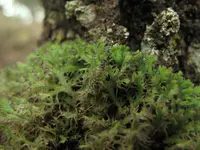
Great ciliated lichen, Anaptychia ciliaris, is a foliose lichen, not a true plant, formed by a partnership between a fungus and photosynthetic algae. It typically forms gray to brown, leafy rosettes with long, eyelash-like cilia along the lobe edges, giving it a distinctive, fringed appearance.
It commonly grows on nutrient-rich bark of trees, old fruit trees, and sometimes on rocks, mainly in clean-air regions across Europe and parts of North America. This species is sensitive to air pollution and environmental disturbance, which makes it challenging to keep in cultivation.
Those trying to care for Great Ciliated Lichen need to provide stable, cool conditions with high humidity, gentle light, and clean, well-ventilated air, often outdoors or in specialized setups.

Care Difficulty
Hard Care

Light Preference
Partial Sun

Water Requirements
Low Water

Temperature Preference
Cool Climate

Hardiness Zone
5–9

Soil Texture
Rocky, Sandy

Soil pH
Slightly acidic (6.5–7.0), Neutral (7.0)

Soil Drainage
Well-drained

Fertilization
Minimal (feed rarely)
Scan your plant to receive care tips personalized for your specific plant
Available on iOS and Android
This lichen prefers bright, open conditions similar to exposed tree bark or rock faces.
Anaptychia ciliaris relies mainly on natural rainfall and air moisture rather than frequent direct watering.
This lichen is adapted to temperate climates with cool to mild conditions and marked seasonal variation.
This lichen prefers cool, consistently moist air rather than dry indoor conditions.
Anaptychia ciliaris does not need conventional soil and instead anchors to mineral or bark surfaces.
This species is only marginally suitable for container culture and is best treated as a mounted lichen rather than a potted plant.
Anaptychia ciliaris (Great Ciliated Lichen) generally does not need fertilization when growing on suitable natural substrates.
Anaptychia ciliaris requires minimal pruning, focused only on health and safety of the host surface.
This lichen is usually not repotted but may be transplanted carefully when relocating it to a new support.
Propagation of Anaptychia ciliaris is slow and mainly of interest for conservation or educational setups rather than routine home culture.
This lichen is naturally cold hardy and usually needs no special winter care in temperate climates.

Plant Health Check
Not sure what's wrong with your plant? Check your plant's health inside the app.
This species often thrives in areas with elevated nitrogen in the air, such as near farmland or urban zones, and its presence or absence has been used as an indicator of changing air pollution levels in Europe.
The lobes of this lichen carry long, dark, hair-like cilia along their edges, a diagnostic feature that helps distinguish it from many similar foliose lichens on tree bark and rocks.
It usually partners with green algae as its main photosynthetic symbiont but can also contain cyanobacteria in tiny internal structures called cephalodia, allowing it to fix atmospheric nitrogen under certain conditions.

Historically, this lichen was much more widespread in industrial regions of Europe, but its marked decline during the 20th century became a textbook example of how sensitive lichens can serve as early-warning organisms for sulfur dioxide air pollution.
Growth is very slow. Thalli typically extend only a few millimeters per year, depending on air quality, moisture, and light. In clean, stable environments, patches can gradually expand over many years without noticeable seasonal surges.
Keep your plants happy and healthy with plant identification, disease detection, and easy care guidance.

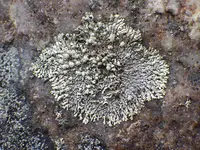
Mougeot's xanthoparmelia lichen
Xanthoparmelia mougeotii
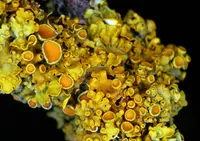
orange wall lichen
Xanthoria parietina
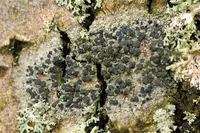
Tiny button lichen
Amandinea punctata
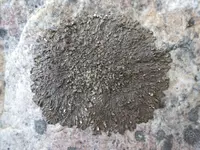
Blistered Camouflage Lichen
Xanthoparmelia loxodes
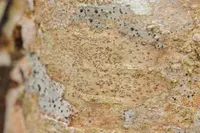
Coniocarpon cinnabarinum
Coniocarpon cinnabarinum
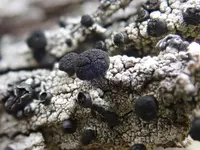
Cupped Soot Lichen
Acolium inquinans
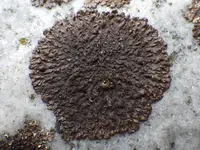
Warty Camouflage Lichen
Xanthoparmelia verruculifera
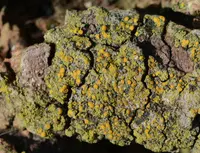
Scythioria phlogina
Scythioria phlogina