


Select stable substrates
Attach thalli only to hard, non-reactive surfaces such as untreated rock, tile, or inert ceramic, since porous wood or soft mortar can hold too much moisture and encourage decay of the lichen base.

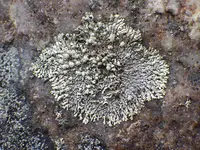
Mougeot's xanthoparmelia lichen, Xanthoparmelia mougeotii, is a foliose lichen, not a true plant. It forms flat, leafy crusts that cling tightly to rocks. The surface is usually yellow-green to gray-green, with small, often curled lobes.
This lichen naturally occurs on sunny, exposed rocks in temperate and montane regions, especially in Europe and parts of North America. It grows slowly and can be sensitive to air pollution and physical disturbance.
Because it relies on clean air, stable rock surfaces, and a balance of moisture from rain and mist, it is challenging to keep in cultivation. Anyone who wants to care for Mougeot's xanthoparmelia lichen should aim to mimic cool, bright, open conditions with good air movement and minimal handling.

Care Difficulty
Moderate Care

Light Preference
Full Sun

Water Requirements
Low Water

Temperature Preference
Cold Hardy

Hardiness Zone
3–9

Soil Texture
Rocky, Sandy

Soil pH
Strongly acidic (4.5–5.5), Acidic (5.5–6.5)

Soil Drainage
Well-drained

Fertilization
Minimal (feed rarely)
Scan your plant to receive care tips personalized for your specific plant
Available on iOS and Android
This crustose lichen prefers bright, open conditions similar to sun-exposed rocks in nature.
This lichen evolved for dry, fast-draining habitats and is highly sensitive to excess moisture.
This species is cold-hardy and adapted to exposed, fluctuating temperatures on rock surfaces.
This crustose lichen prefers cool, moderately moist air but tolerates brief drying.
This saxicolous lichen does not grow in typical potting soil and instead anchors to rock-like substrates.
This species can be maintained in shallow containers as a display of attached rock rather than as a rooted plant.
This lichen does not need fertilization and performs best on nutrient-poor rock or bark surfaces.
Xanthoparmelia mougeotii needs no true pruning, only occasional hygiene cleaning.
Transplanting is rarely required, as this rock-dwelling lichen is usually left undisturbed in situ.
Propagation of this lichen is slow and mainly done by relocating small natural fragments.
This species is very cold hardy and normally needs no special winter care outdoors.

Plant Health Check
Not sure what's wrong with your plant? Check your plant's health inside the app.
This lichen is strongly associated with siliceous rocks such as granite and schist in subalpine and alpine zones, especially in European mountain systems like the Alps and Pyrenees.
It typically forms 8-spored asci (spore-bearing sacs) with simple, colorless ascospores, a microscopic feature that helps distinguish it from closely related Xanthoparmelia species.
Chemical tests and chromatography show that its thallus contains characteristic lichen substances such as usnic acid and stictic acid derivatives, which contribute to its yellow-green color and help separate it from similar species with different chemotypes.
Growth is slow. Many crusts expand only a few millimeters per year, depending on moisture, air quality, and substrate stability. Disturbance, handling, or pollution can reduce growth further, so avoid frequent touching or moving established patches.
Keep your plants happy and healthy with plant identification, disease detection, and easy care guidance.

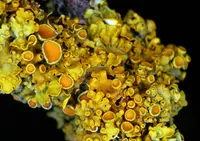
orange wall lichen
Xanthoria parietina
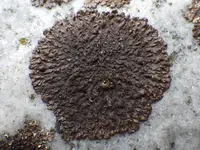
Warty Camouflage Lichen
Xanthoparmelia verruculifera
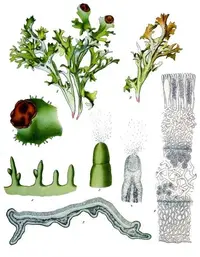
island cetraria lichen
Cetraria islandica
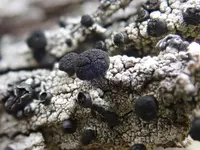
Cupped Soot Lichen
Acolium inquinans
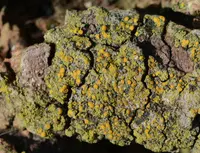
Scythioria phlogina
Scythioria phlogina
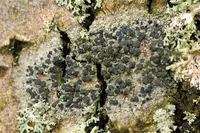
Tiny button lichen
Amandinea punctata
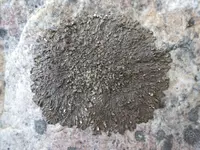
Blistered Camouflage Lichen
Xanthoparmelia loxodes
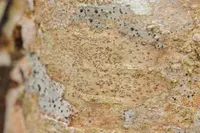
Coniocarpon cinnabarinum
Coniocarpon cinnabarinum