Encourage Dense Clumps
Cut back and lightly rake out old, lodged stems in late winter to early spring so new shoots receive light and air, which encourages tighter, more wind-resistant clumps.

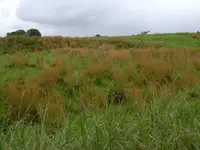
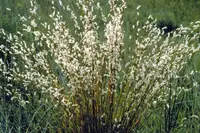
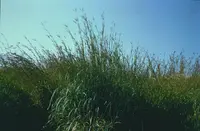
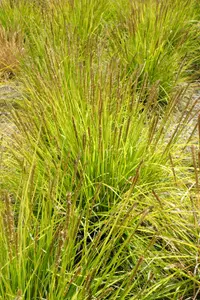
Broomsedge bluestem (Andropogon virginicus) is a warm-season perennial bunchgrass native to much of eastern and central North America. It commonly grows in old fields, roadsides, and open woodlands.
The plant forms upright clumps with narrow, wiry leaves that turn coppery orange to straw-colored in fall and winter, giving strong seasonal interest. Its airy seed heads sit above the foliage and are easily moved by wind.
This grass tolerates poor, dry, and acidic soils and often colonizes disturbed or low-fertility sites, which makes it relatively easy to maintain once established. Those learning how to care for broomsedge bluestem should note that it prefers full sun and does best in well-drained conditions.

Care Difficulty
Easy Care

Light Preference
Full Sun

Water Requirements
Low Water

Temperature Preference
Cold Hardy

Hardiness Zone
4–9

Soil Texture
Sandy, Loamy, Clay

Soil pH
Acidic (5.5–6.5), Slightly acidic (6.5–7.0)

Soil Drainage
Well-drained

Fertilization
Minimal (feed rarely)
Scan your plant to receive care tips personalized for your specific plant
Available on iOS and Android
This warm-season grass prefers open, sunny sites for strongest growth and color.
This species is naturally drought-tolerant and prefers drier, well-drained conditions once established.
This warm-season perennial grass thrives in hot summers and tolerates a wide range of outdoor temperatures.
Humidity is not a critical factor for Andropogon virginicus, which is adapted to open, dry habitats.
Andropogon virginicus prefers lean, well-drained, often sandy soils and tolerates low fertility.
This species can grow in containers for ornamental or restoration use if the pot and medium are chosen carefully.
Andropogon virginicus typically thrives in poor soils and needs little or no fertilizer once established.
Pruning Andropogon virginicus focuses on seasonal cleanup rather than shaping.
Transplanting broomsedge bluestem is mainly done to reposition clumps or renew crowded plantings.
Andropogon virginicus is commonly propagated by division or seeds.
This species is cold hardy in much of its range and generally needs minimal winter care outdoors.

Plant Health Check
Not sure what's wrong with your plant? Check your plant's health inside the app.
This grass is one of the first species to establish on abandoned fields and disturbed, nutrient-poor sites in the eastern United States, helping stabilize soil while other plant species gradually move in.
Research indicates that this species releases chemical compounds into the soil that can suppress the germination and growth of some competing plants, a phenomenon known as allelopathy.
Its persistent, stiff winter stems and dense clumps provide cover and nesting structure for small mammals and ground-nesting birds long after many other grasses have collapsed.

Genetic and field studies show that this species often forms dense, almost monocultural stands in old fields because it combines high seed production, tolerance of very low soil fertility, and an ability to thrive under recurring fire, giving it a strong advantage over many other grasses in frequently burned landscapes.
This warm-season bunchgrass spreads mainly by seed, not rhizomes, so it forms clumps rather than dense sod. In poor, disturbed soils it can colonize quickly, but in managed plantings it is usually manageable with periodic thinning and mowing.
Keep your plants happy and healthy with plant identification, disease detection, and easy care guidance.