Mark Dormant Clumps
Flag or discreetly mark clumps while foliage is still green so you can avoid disturbing the corms during their long summer dormancy and plan division or nearby digging accurately in the following dormant season.

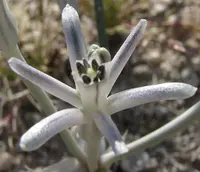
Pink funnel lily, Androstephium breviflorum, is a small spring-blooming bulb from arid regions of the western United States. It belongs to the asparagus family and forms slender, grass-like leaves with delicate starry flowers that appear on thin stems. The plant grows in open desert or dry grassland habitats, often in sandy or rocky soils with excellent drainage. Its compact size and brief active season make it relatively easy to manage, but it can be short-lived or fail if kept too wet. For those who want to care for pink funnel lily, dry, sunny conditions and lean, well-drained soil are the main priorities.

Care Difficulty
Moderate Care

Light Preference
Full Sun

Water Requirements
Low Water

Temperature Preference
Cold Hardy

Hardiness Zone
5–9

Soil Texture
Sandy, Loamy, Rocky

Soil pH
Slightly acidic (6.5–7.0), Neutral (7.0)

Soil Drainage
Well-drained

Fertilization
Minimal (feed rarely)
Scan your plant to receive care tips personalized for your specific plant
Available on iOS and Android
This small desert geophyte prefers bright, open light similar to native sagebrush steppe conditions.
This bulb-forming wildflower prefers brief moisture pulses followed by dry periods, similar to its native desert steppe.
This species is adapted to cold winters and mild, bright springs, with summer dormancy in hotter, drier conditions.
Humidity is rarely a concern for this species and it performs well in dry climates.
This bulb prefers loose, fast-draining mineral soils that stay dry between waterings.
This species can be grown in containers if the pot and medium replicate its dry, sandy habitat.
Androstephium breviflorum is a small bulbous native that needs only light feeding in lean soils to maintain flowering.
Pruning needs for Androstephium breviflorum are minimal and focus mainly on post-bloom cleanup.
This species is usually grown in the ground, so focus on careful lifting and transplanting of bulbs rather than frequent repotting.
Androstephium breviflorum is most commonly propagated by seed and by dividing small bulb clusters during dormancy.
This bulb is generally cold hardy in much of its native range and often needs only basic winter attention in the ground.

Plant Health Check
Not sure what's wrong with your plant? Check your plant's health inside the app.
This Great Basin and Intermountain West native emerges from a small underground corm and typically flowers for a brief window in early spring, often before many surrounding desert plants have leafed out.
Field studies show that its pale lilac, funnel-shaped flowers are mainly pollinated by small native ground-nesting bees, which track its short flowering season in open sagebrush and desert grassland habitats.
Although it looks like a small lily with starry flowers, this species belongs to the asparagus family (Asparagaceae), reflecting modern DNA-based reclassification of many former lily-like plants.

Androstephium breviflorum often forms loose, scattered colonies from its corms, creating delicate, low patches of flowers that can visually mark old, lightly disturbed sites such as historic grazing areas and former wagon routes in parts of the Great Basin.
Lack of blooms usually comes from insufficient winter chill, too much shade, or overcrowded corms. This species needs a cool dormant period, full sun in spring, and division every few years to maintain flowering.
Keep your plants happy and healthy with plant identification, disease detection, and easy care guidance.