Post-bloom handling
After flowers fade, cut only the spent flower stalk down to the bulb neck but leave all healthy leaves so the plant can recharge for next year’s flowering.

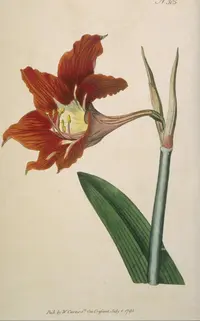
Barbados lily, Hippeastrum puniceum, is a bulb-forming perennial often grown for its large, trumpet-shaped orange to red flowers. It usually sends up sturdy, leafless flower stalks followed by strappy green leaves.
This species is native to tropical regions of the Americas but is now widely cultivated in warm climates and as a seasonal indoor bulb. It is generally easy to grow if the bulb is kept well-drained and not overwatered.
Those learning how to care for Barbados lily should focus on bright light, moderate watering, and loose, well-draining soil to support reliable flowering and healthy bulbs.

Care Difficulty
Easy Care

Light Preference
Full Sun

Water Requirements
Moderate Water

Temperature Preference
Tropical / Frost Sensitive

Hardiness Zone
9–11

Soil Texture
Sandy, Loamy, Organic-rich

Soil pH
Acidic (5.5–6.5), Slightly acidic (6.5–7.0)

Soil Drainage
Well-drained

Fertilization
Light (every 4–6 weeks)
Scan your plant to receive care tips personalized for your specific plant
Available on iOS and Android
Hippeastrum puniceum grows best with bright light and some protection from harsh midday sun.
Watering Hippeastrum puniceum correctly focuses on moist but never waterlogged soil and clear seasonal changes.
Stable, warm conditions support strong growth and flowering for this bulb species.
This species handles typical indoor humidity but benefits from moderate levels for best flowering.
Hippeastrum puniceum prefers a loose, well-aerated, sharply draining mix that keeps the bulb slightly dry around the neck.
This bulb is very suitable for container growing, both indoors and outdoors in mild climates.
A modest, targeted feeding program supports strong bulbs and flowering in Barbados lily without forcing weak, lush growth.
Pruning Hippeastrum puniceum focuses on removing spent tissues to direct energy back into the bulb.
Container-grown plants benefit from occasional repotting, while garden clumps of Hippeastrum puniceum are best lifted only when overcrowded.
This species is commonly multiplied by bulb division and, less often, from seed for genetic diversity.
Winter care for Hippeastrum puniceum depends on climate and whether plants grow in ground or containers.

Plant Health Check
Not sure what's wrong with your plant? Check your plant's health inside the app.
Although native to South America, this species has long escaped cultivation and naturalized throughout tropical and subtropical regions, especially in South and Southeast Asia, where it often forms self-sustaining colonies along roadsides and in old gardens.
Unlike many large-flowered hybrid amaryllis with broad, overlapping petals, this species typically has narrower, more open tepals and a characteristic orange-red color with a greenish throat, which makes its wild-type origin easy to recognize.
It was one of the earliest Hippeastrum species moved into colonial botanical gardens and used in breeding, which helped establish the popularity of amaryllis-like bulbs as ornamental plants in warm climates.

This species is so well established outside its native range that in parts of India, Sri Lanka, and other tropical countries it is commonly mistaken for a native wildflower rather than a long-ago introduced ornamental.
Lack of flowering usually comes from insufficient light, overcrowded bulbs, or no distinct rest period. Allow foliage to mature fully, keep bulbs slightly pot-bound, then provide a cooler, drier rest before the next growth cycle to reset blooming.
Keep your plants happy and healthy with plant identification, disease detection, and easy care guidance.