Provide sturdy staking
Install tall, rigid stakes or mesh supports early in the season and tie stems loosely with soft ties at 20–30 cm intervals to prevent wind damage and leaning as the long stems and heavy flowers develop.

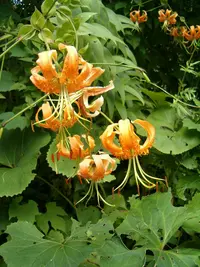
Henry's lily, Lilium henryi, is a hardy, bulb-forming perennial lily valued for its tall stems and gracefully recurved, orange, spotted flowers. Plants typically produce strong, upright stalks with whorled leaves, creating a vertical accent in mixed borders or naturalistic plantings.
This species is native to central China, where it grows on rocky slopes and forest edges, which explains its tolerance for cool conditions and well-drained, humus-rich soils. It is considered one of the easier species lilies for gardeners who want to learn how to care for Henry's lily without dealing with very demanding conditions.
Henry's lily adapts well to temperate gardens, preferring bright light with some protection from the hottest sun and consistently moist but not waterlogged soil.

Care Difficulty
Moderate Care

Light Preference
Full Sun

Water Requirements
Regular Water

Temperature Preference
Cold Hardy

Hardiness Zone
4–8

Soil Texture
Loamy, Sandy, Organic-rich

Soil pH
Acidic (5.5–6.5), Slightly acidic (6.5–7.0)

Soil Drainage
Moist but well-drained

Fertilization
Light (every 4–6 weeks)
Scan your plant to receive care tips personalized for your specific plant
Available on iOS and Android
This species prefers bright outdoor conditions with some protection from intense afternoon radiation.
This lily prefers steady soil moisture without remaining waterlogged around its bulbs.
This hardy lily tolerates a wide temperature range but grows best in moderate conditions.
This species grows well in typical outdoor humidity and only rarely needs special humidity management.
Lilium henryi prefers deep, moist, well-drained, humus-rich soil that stays cool around the bulbs.
This species can be grown successfully in containers if the pot is deep and drainage-focused.
This lily responds well to moderate feeding during active growth.
Lilium henryi needs only light, purposeful pruning to maintain health and flowering.
This species is usually grown in borders, so care focuses on occasional lifting and transplanting rather than frequent repotting.
Lilium henryi is commonly propagated by bulb division and, more slowly, from seed.
This lily is fairly cold hardy in much of the US but benefits from simple winter preparation.

Plant Health Check
Not sure what's wrong with your plant? Check your plant's health inside the app.
The flowers have strongly reflexed tepals that curl backward into a distinct Turk's cap shape, exposing the stamens and making pollen easily accessible to pollinators like bees and butterflies.
The orange petals are often heavily spotted and covered with small raised bumps called papillae, giving the flowers a textured surface that is characteristic of this species among lilies.
Unlike many lilies with strictly upright stems, this species can develop tall, somewhat twining stems that lean on or weave through nearby shrubs and supports in its native mountain habitats.

This species was first described scientifically in the late 19th century from plants collected in Hubei, China, and it later became an important breeding parent in the development of several modern garden lilies due to its distinctive flower form and strong stems.
Lack of blooms usually comes from insufficient sun, depleted soil nutrients, overcrowded bulbs, or bulbs planted too shallow or deep. Ensure full sun, balanced fertilization, and divide congested clumps every few years to restore flowering.
Keep your plants happy and healthy with plant identification, disease detection, and easy care guidance.