Rhizome Division Timing
Lift and divide congested clumps every 3–4 years in late summer after flowering, trimming foliage to 10–15 cm to reduce stress and encourage vigorous new fans.

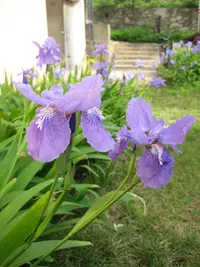
Wall iris, Iris tectorum, is a rhizomatous perennial often used as a low, spreading accent in borders, rock gardens, and shaded courtyards. It forms fans of broad, sword-like leaves and produces relatively large, flat, frilled flowers in shades of lavender, blue, or white. This species is native to China and Japan, where it often grows on slopes, old walls, and disturbed sites with good drainage. It is generally considered easy to moderate to grow, as long as the soil does not stay waterlogged and the site provides bright light with some protection from intense midday sun. Understanding how to care for wall iris mainly involves managing drainage, seasonal moisture, and division of crowded clumps.

Care Difficulty
Moderate Care

Light Preference
Partial Sun

Water Requirements
Moderate Water

Temperature Preference
Cold Hardy

Hardiness Zone
4–9

Soil Texture
Loamy, Sandy, Organic-rich

Soil pH
Acidic (5.5–6.5), Slightly acidic (6.5–7.0)

Soil Drainage
Well-drained

Fertilization
Minimal (feed rarely)
Scan your plant to receive care tips personalized for your specific plant
Available on iOS and Android
Iris tectorum performs best with bright, cool light and protection from intense afternoon sun.
Water Iris tectorum to keep soil consistently moist but never waterlogged.
This species prefers moderate climates with cool to mild winters and not excessively hot summers.
Iris tectorum handles a wide humidity range but grows best in moderate, stable air moisture.
Iris tectorum prefers loose, well-aerated, moisture-retentive but free-draining soil.
This species is well suited to container growing outdoors when the pot is prepared for its shallow rhizomes.
Iris tectorum benefits from modest, balanced feeding during its active growing season.
Pruning Iris tectorum focuses on hygiene and maintaining strong flowering clumps.
Transplanting Iris tectorum is mostly about dividing and resetting crowded rhizomes in garden beds.
Iris tectorum is most commonly propagated by division, with seed used mainly for breeding or larger projects.
Iris tectorum is moderately cold hardy and usually needs only light winter care in most temperate gardens.

Plant Health Check
Not sure what's wrong with your plant? Check your plant's health inside the app.
In parts of China and Japan, this species was historically planted on thatched roofs, where its rhizomes helped anchor the thatch and its drought tolerance allowed it to survive in the thin, exposed substrate.
Unlike many bearded irises, this species often keeps functional foliage through mild winters, forming low, fan-shaped clumps that can remain semi-evergreen in temperate climates.
Its flowers lack the full fuzzy beard seen in bearded irises and instead have a low ridge or crest on the falls, often marked with vivid blue or purple veins and orange to yellow signals that guide pollinators.

Molecular and morphological studies place this species in a small group of closely related East Asian irises, and it has been used as a parent in breeding compact, roof- and rock-garden-suited hybrids that retain its broad, flat flower form and distinctive crested falls.
Lack of flowers often comes from too much shade, crowded rhizomes, or very nitrogen‑rich fertilizer. Divide clumps every 3–4 years, ensure several hours of direct light, and use a balanced or low‑nitrogen formula to restore flowering.
Keep your plants happy and healthy with plant identification, disease detection, and easy care guidance.