Mulch For Cool Roots
Apply a 3–5 cm layer of fine bark or leaf mold around the clumps each spring to keep roots cool, suppress weeds, and maintain stable soil moisture without burying the crown.

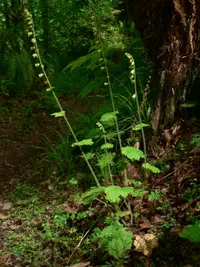
Bigflower tellima (Tellima grandiflora) is a compact herbaceous perennial grown mainly for its fresh green, often softly textured foliage and airy flower spikes. It forms low clumps that slowly spread, making it useful as a woodland groundcover or edging plant. Tall, slender stems carry many small, fringed, bell-shaped flowers that shift from greenish white to pinkish tones as they age.
This species is native to moist forests and stream banks of western North America, so it naturally prefers cool conditions and consistent moisture. It is considered easy to moderate to grow, as it tolerates shade, cool summers, and a range of garden soils if they are not very dry. Gardeners who learn how to care for bigflower tellima usually find it reliable in woodland and shade borders.

Care Difficulty
Easy Care

Light Preference
Partial Shade

Water Requirements
Regular Water

Temperature Preference
Cold Hardy

Hardiness Zone
4–8

Soil Texture
Loamy, Silty, Organic-rich

Soil pH
Acidic (5.5–6.5), Slightly acidic (6.5–7.0)

Soil Drainage
Moist but well-drained

Fertilization
Minimal (feed rarely)
Scan your plant to receive care tips personalized for your specific plant
Available on iOS and Android
This shade-loving perennial thrives in cool, filtered light conditions outdoors.
This woodland species prefers evenly moist but not saturated soil.
This hardy perennial is adapted to cool, temperate climates with cold winters.
This shade perennial handles a wide humidity range but prefers moderately moist air.
Tellima grandiflora grows best in loose, moisture-retentive but free-draining soil.
This species adapts well to container growing on shaded patios or balconies.
This woodland perennial needs only light feeding when grown in average garden soil.
Pruning needs for Tellima grandiflora are modest and focus on cleanliness and tidiness.
This species is usually grown in the ground, so focus on transplanting clumps rather than frequent repotting.
Tellima grandiflora is commonly propagated by seed or division to maintain healthy plantings.
This plant is generally cold hardy and needs minimal winter care in most temperate gardens.

Plant Health Check
Not sure what's wrong with your plant? Check your plant's health inside the app.
This species flowers very early in the woodland season, sending up tall racemes of small, fringed, greenish-white flowers while many canopy trees are still leafing out, which allows it to take advantage of higher early-season light levels on the forest floor.
The tiny bell-shaped flowers often have a faint, spicy-sweet fragrance that is more noticeable in cool, moist conditions and is thought to help attract small pollinating insects such as gnats and short-tongued flies in its native Pacific Northwest forests.
It forms a persistent basal rosette of rounded, scalloped leaves that can overwinter in mild climates, allowing the plant to store resources in its crown and quickly resume growth and flowering as soon as soil temperatures rise.

Molecular phylogenetic studies have shown that this species, once grouped in the saxifrage family Saxifragaceae in a broad sense, helped clarify the modern, narrower circumscription of the family by highlighting a close evolutionary relationship with Heuchera and other North American woodland genera.
This species spreads moderately by short rhizomes and self-seeding, forming loose clumps rather than dense mats. It usually stays manageable in temperate gardens, but removing spent flower stalks before seeds drop helps control unwanted spread.
Keep your plants happy and healthy with plant identification, disease detection, and easy care guidance.