woodland angelica Care (Angelica sylvestris)

Also known as: wild angelica
woodland angelica

About woodland angelica

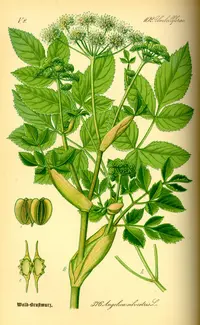
Woodland angelica (Angelica sylvestris) is a tall, short-lived perennial herb in the carrot family, often found in damp meadows and light woodlands. It forms upright, hollow stems with divided, glossy green leaves.

Large, rounded umbels of white to pale pink flowers appear in summer, attracting many pollinators. The plant usually self-seeds, so a colony can establish where conditions suit it.

It prefers moist, fertile soil and cool to mild climates, which makes it easier in northern regions than in hot, dry areas. Gardeners who learn how to care for woodland angelica usually find it undemanding if soil does not dry out for long periods.

Main Plant Requirements

Care Difficulty

Moderate Care

Light Preference

Partial Shade

Water Requirements

Regular Water

Temperature Preference

Cold Hardy

Hardiness Zone

4–9

Soil Texture

Loamy, Silty, Organic-rich

Soil pH

Acidic (5.5–6.5), Slightly acidic (6.5–7.0)

Soil Drainage

Moist but well-drained

Fertilization

Minimal (feed rarely)

Get Personalized Care Plan

Scan your plant to receive care tips personalized for your specific plant

Available on iOS and Android

How to Care for the woodland angelica

This shade-loving perennial prefers cool, moist sites with gentle light exposure.

  • Provide 3–5 hours of morning sun with light or dappled shade the rest of the day, similar to a bright woodland edge for woodland angelica.
  • Tolerates partial to full shade, but in deep shade stems may stretch, and flowering can be reduced; aim for filtered light under taller plants or trees.
  • Avoid strong afternoon sun, especially in summer, which can scorch foliage and dry soil quickly; use neighboring plants or structures for protection.

This plant prefers consistently moist soil without staying waterlogged.

  • Water when the top 2–4 cm of soil feels slightly dry, aiming to keep the root zone evenly moist during active growth in spring and early summer.
  • Use deep, occasional soakings rather than light sprinkling so water reaches 15–20 cm deep; well-drained, humus-rich soil helps prevent root rot in Angelica sylvestris.
  • Reduce watering in late autumn as growth slows; wilting, crisp leaves indicate dryness, while yellowing, soft stems or a sour smell suggest overwatering.

This hardy perennial is adapted to cool to mild temperate climates.

  • Best growth occurs around 55–70°F (13–21°C), with strong vegetative growth in cool, moist spring and early summer weather.
  • Mature plants tolerate winter down to about 5–10°F (-15 to -12°C) in the ground when soil is not waterlogged, dying back above ground and resprouting in spring.
  • In hot spells above 80–85°F (27–29°C), growth can slow and leaves may droop; provide extra shade and moisture to reduce heat stress and leaf scorch.

This species prefers moderate to high humidity but usually copes with typical outdoor levels.

  • Aim for 50–70% humidity in sheltered sites, such as near ponds or moist borders.
  • Tolerates short dry spells, but prolonged very dry air can cause leaf edges to brown and curl.
  • Increase local humidity outdoors by mulching heavily and watering the soil regularly rather than misting.

This plant prefers deep, moist, fertile soil with steady drainage.

  • Use a loamy soil rich in organic matter, such as garden loam mixed with 30–40% compost or well-rotted manure.
  • Ensure drainage is slow but not waterlogged by avoiding heavy, compacted clay that stays saturated after rain.
  • Aim for slightly acidic to neutral pH around 6.0–7.0, which suits Angelica sylvestris in most garden conditions.
  • Improve aeration and structure by working in coarse sand or fine grit where soil is sticky or dense.

This species can be grown in large containers outdoors if the pot size and moisture are carefully managed.

  • Choose a deep, heavy pot to support the tall, top-heavy stems and prevent tipping in wind.
  • Use a moisture-retentive but draining mix, for example 60% peat-free compost with 40% loam and grit.
  • Stand the container inside a wider decorative pot or against a barrier to shield it from strong gusts that can snap stems.

This plant is not nutrient demanding, but light feeding supports strong growth and flowering in woodland angelica.

  • Use a balanced fertilizer (for example 10-10-10) at half-strength or apply a thin layer of garden compost in early spring.
  • Feed every 4–6 weeks during the active growing season if soil is poor or plants show pale, weak growth.
  • Avoid high-nitrogen lawn products, which encourage soft, floppy stems instead of sturdy flowering stalks.
  • Stop feeding in late summer and do not fertilize in winter dormancy to prevent soft, frost-prone growth.

Pruning Angelica sylvestris is minimal and mainly maintains plant health and manages self-seeding.

  • In late winter or early spring, remove dead or damaged stems at the base with clean hand pruners.
  • After flowering, cut back spent flower stalks before seeds ripen if self-seeding needs control.
  • Leave some seed heads if natural reseeding is desired, then remove collapsed stems once they dry.
  • Avoid heavy cutting into young, leafy shoots, as this can reduce vigor and flowering potential.

Angelica sylvestris is usually grown in open ground, so focus on careful transplanting rather than frequent repotting.

  • Transplant young plants in early spring or early fall when temperatures are mild and soil is evenly moist.
  • Move seedlings before roots become deeply anchored; older plants resent disturbance and may not re-establish well.
  • Choose a site with deep, loose soil and set the crown at the same level as before, firming soil gently around roots.
  • Water thoroughly after planting and keep soil consistently moist for 2–3 weeks to reduce transplant shock.

New Angelica sylvestris plants are most often raised from seed, with some natural self-sowing in suitable sites.

  • Collect ripe seeds in late summer and sow fresh in trays or directly outdoors, as viability drops with storage time.
  • Use a moist, free-draining seed mix and keep at 60–68°F; light cold exposure can improve germination.
  • Space seedlings out once they have 2–3 true leaves, handling by leaves rather than delicate stems.
  • Division is rarely practical because mature plants have deep taproots and do not respond well to being split.

Angelica sylvestris is generally cold hardy in temperate climates and needs only simple winter care.

  • After the first hard frost, allow top growth to die back, then cut stems close to ground level if tidy appearance is preferred.
  • Apply a 5–8 cm layer of organic mulch around the root zone in colder regions to moderate soil temperature.
  • Container-grown plants in very cold areas can be moved to a sheltered, unheated space to prevent root freezing.

Care Tips

Staking Tall Stems

Install sturdy stakes or a low ring support around young plants in early summer so the tall hollow stems stay upright and do not snap in wind or heavy rain.

Mulch For Cool Roots

Apply a 5–7 cm layer of organic mulch around the base, keeping it a few cm away from the stems, to keep roots cool, conserve moisture, and suppress competing weeds.

Self-Seed Management

If you want controlled clumps rather than a spreading colony, cut the seed heads just as they turn brown and bag them, or leave only a few umbels to ripen for intentional reseeding.

Succession Replanting

Because plants are short-lived and often monocarpic, mark locations and start new seedlings nearby every 1–2 years so flowering plants can be replaced without gaps in the border.

Slugs And Snails Patrol

Protect young rosettes in spring with physical barriers or iron phosphate pellets, and regularly remove hiding spots like dense debris, since tender foliage is highly attractive to slugs and snails when growing woodland angelica.

Common Pests and Diseases

Leaf spot

This disease causes brown, tan, or black spots on leaves, sometimes with a yellow halo, and can lead to premature leaf drop in damp conditions.

Solution

Remove and discard affected leaves to reduce inoculum, avoid overhead watering, and improve air movement around plants; in persistent wet weather, a copper-based fungicide labeled for herbaceous ornamentals can be used according to label directions as part of broader Angelica sylvestris care.

Powdery mildew

This disease produces a white, powdery coating on upper leaf surfaces and stems, which can cause leaf distortion and reduced vigor in crowded or shaded sites.

Solution

Thin surrounding vegetation to increase light and airflow, avoid high-nitrogen fertilization, and remove heavily infected leaves; if needed, apply a sulfur or potassium bicarbonate fungicide labeled for powdery mildew, ensuring thorough coverage of foliage.

Aphids

These insects cluster on young stems, leaf undersides, and flower stalks, sucking sap and excreting sticky honeydew that can attract sooty mold.

Solution

Dislodge colonies with a firm stream of water, pinch off or cut back heavily infested shoot tips, and encourage natural predators like lady beetles; for ongoing problems, use insecticidal soap or a light horticultural oil, making sure to cover the undersides of leaves.

Leaf miners

These insects create pale, winding tunnels inside angelica leaves, which can lead to cosmetic damage and reduced photosynthesis on heavily affected foliage.

Solution

Remove and dispose of mined leaves as soon as damage appears, and avoid letting infested foliage remain on the ground; in recurring cases, use row covers over young plants and, if needed, apply a systemic insecticide specifically labeled for leaf miners on ornamental or herb plants, following all label restrictions.

Crown and stem canker

This disease causes dark, sunken lesions at the crown or along lower stems, sometimes girdling shoots and leading to wilting or collapse, especially in poorly drained or overcrowded plantings.

Solution

Cut out and destroy affected stems at the base, improve drainage and spacing, and avoid wounding the crown; in beds with repeated issues, rotate away from Apiaceae (carrot family) for several years and consider using a fungicidal drench labeled for crown or stem cankers if cultural steps alone do not stop disease spread.

Interesting Facts

Native European umbel

This species is native across much of Europe and western Asia, where it grows in damp meadows, woodland edges, riverbanks, and roadside ditches, showing a strong preference for moist but not waterlogged soils.

Important nectar source

Its pale pink to white umbels provide abundant nectar and pollen from mid to late summer, supporting a wide range of insects including hoverflies, solitary bees, and beetles in semi-natural landscapes.

Short-lived perennial habit

It behaves as a short-lived perennial or sometimes biennial, often putting strong energy into a single major flowering season and then declining, which is typical of many large umbellifers adapted to disturbed or open habitats.

Botan icon

Did you know?

In several European countries, it hybridizes naturally with related angelica species, and these hybrids can be difficult to distinguish from the parent plants, which has caused ongoing discussion among botanists about how to classify local angelica populations.

FAQs about woodland angelica

This species self-seeds readily and can form loose colonies, but is usually not aggressively spreading in typical garden conditions. Deadhead seed heads before they ripen if you want to limit its spread and volunteer seedlings.

Grow Healthy Plants with Botan Care

Keep your plants happy and healthy with plant identification, disease detection, and easy care guidance.

Botan plant care app — identify plants on mobile

Explore More Plants