Sturdy stem support
Install tall, rigid stakes or a light wire cage early in the season so the hollow, heavy flowering stems are supported before strong winds or heavy rain can bend or snap them.

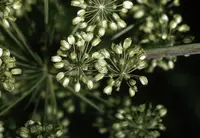
Purplestem angelica (Angelica atropurpurea) is a tall, moisture-loving perennial herb in the carrot family, known for its deep purple, hollow stems and large, divided leaves. It forms broad, rounded clusters of small greenish-white flowers that attract many pollinators.
This species is native to wet meadows, marsh edges, and stream banks in eastern and central North America, where it often grows in full sun to light shade. It prefers consistently damp, rich soil and cool to mild summer conditions, which can make it challenging in hot, dry climates. Gardeners who learn how to care for purplestem angelica usually focus on providing enough moisture and preventing the soil from drying out.

Care Difficulty
Moderate Care

Light Preference
Partial Sun

Water Requirements
Keep Soil Moist

Temperature Preference
Cold Hardy

Hardiness Zone
4–9

Soil Texture
Loamy, Silty, Organic-rich

Soil pH
Acidic (5.5–6.5), Slightly acidic (6.5–7.0)

Soil Drainage
Moist but well-drained

Fertilization
Minimal (feed rarely)
Scan your plant to receive care tips personalized for your specific plant
Available on iOS and Android
This moisture-loving perennial prefers cool, bright conditions without harsh midday exposure.
This plant thrives in consistently moist, never stagnant, soil similar to streamside conditions.
This cool-temperate species prefers moderate summers and cold winters for proper growth and dormancy.
Humidity is not a major factor for Angelica atropurpurea, which grows comfortably in typical outdoor conditions of 40–60% humidity.
Angelica atropurpurea prefers deep, moist, fertile soil that stays evenly damp but not waterlogged.
This species can be grown in large containers, but it is better suited to deep beds or open ground.
This North American native herb needs only light feeding in average garden soil.
Pruning needs for Angelica atropurpurea are simple and mostly maintenance focused.
This species is usually grown in the ground, so management focuses on careful transplanting rather than frequent repotting.
Propagation of Angelica atropurpurea is mainly done by seed, as the plant has a strong taproot and does not divide well.
This hardy perennial tolerates typical winters in much of its native range with minimal intervention.

Plant Health Check
Not sure what's wrong with your plant? Check your plant's health inside the app.
This species is native to eastern North American wetlands and floodplains, where it grows in saturated soils along rivers, swamps, and wet meadows, helping stabilize banks and support moist-soil ecosystems.
Mature plants develop striking dark purple, often hollow stems that can reach more than 2 m tall, which helps distinguish it from many other tall umbellifers in the same habitat.
Its large, many-rayed umbels of small greenish-white flowers provide abundant nectar and pollen, attracting diverse insects including bees, wasps, flies, and beetles over an extended bloom period.

Indigenous peoples in parts of North America historically used this plant in cultural and practical contexts, carefully distinguishing it from similar-looking but highly toxic relatives such as water hemlock, which share wetland habitats and general appearance but differ in stem, root, and leaf characteristics.
The large, umbrella-like flower clusters are highly attractive to many pollinators, especially bees, hoverflies, and some butterflies. It provides nectar and pollen in late spring to summer, supporting beneficial insects in moist meadow or streamside plantings.
Keep your plants happy and healthy with plant identification, disease detection, and easy care guidance.