Root establishment support
Stake young trees with 2–3 sturdy posts placed outside the root zone and use soft, flexible ties, then remove all staking after 1–2 years once the trunk can stand unsupported to avoid girdling and wind-rock damage.

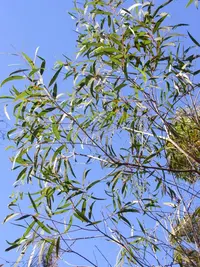
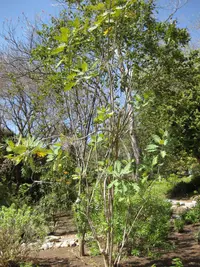
Narrow-leaved apple (Angophora bakeri) is a small to medium evergreen tree from eastern Australia, related to eucalypts. It often forms a multi-stemmed, twisting trunk with fibrous bark and slender, narrow leaves.
In nature it grows on poor, sandy or rocky soils in heath and open woodland, showing strong tolerance to drought and low fertility. The creamy flowers attract insects and birds and are followed by woody seed capsules.
This species suits mild climates, full sun, and well-drained soil, and it copes better with dry conditions than with prolonged waterlogging. Understanding how to care for narrow-leaved apple starts with providing sun, drainage, and space for its root system.

Care Difficulty
Moderate Care

Light Preference
Full Sun

Water Requirements
Low Water

Temperature Preference
Warm Climate

Hardiness Zone
9–11

Soil Texture
Sandy, Loamy, Rocky

Soil pH
Acidic (5.5–6.5), Slightly acidic (6.5–7.0)

Soil Drainage
Well-drained

Fertilization
Minimal (feed rarely)
Scan your plant to receive care tips personalized for your specific plant
Available on iOS and Android
Angophora bakeri grows best in bright, open positions with consistent sun exposure.
Watering should support deep rooting while avoiding prolonged soil saturation.
This species is adapted to mild to warm climates with only brief exposure to cold.
This species tolerates a wide humidity range and rarely needs special humidity management.
This Australian species prefers lean, well-drained, sandy soil with plenty of air around the roots.
This species can be grown in containers for several years when root space and stability are carefully managed.
This native tree usually grows well in poor soils, so caring for narrow-leaved apple focuses on light, not heavy, fertilization.
Pruning Angophora bakeri is mainly about structural safety and maintaining a stable form.
This species is usually grown in the ground, so transplanting young trees correctly is more important than frequent repotting.
Propagation of Angophora bakeri is usually done from seed, with cuttings used less often and requiring more control.
This species is relatively frost-tolerant in mild-winter regions and usually needs minimal winter care once established.

Plant Health Check
Not sure what's wrong with your plant? Check your plant's health inside the app.
This species is one of the smallest members of the Angophora group, often forming a gnarled, multi-stemmed small tree or large shrub with very rough, persistent bark rather than the tall smooth-barked forms seen in many related species.
Angophora bakeri is naturally restricted to nutrient-poor, sandy soils on sandstone in coastal and near-coastal heath and low woodland of New South Wales, showing strong adaptation to low phosphorus and low water-holding capacity substrates.
Like many fire-adapted Australian trees, it forms a substantial lignotuber, a woody swelling at the base of the stem that stores buds and reserves, allowing the plant to resprout vigorously after bushfire or severe damage.

Genetic and morphological studies have shown that Angophora bakeri is sufficiently distinct from nearby Angophora species that some botanists recognize two subspecies within it, reflecting its localized diversification within the sandstone landscapes of New South Wales.
Growth is moderate. Young trees often add 30–60 cm per year once established, slowing as they mature. Rate depends on water availability, soil depth, and exposure. Poor, shallow, or compacted soils noticeably reduce extension growth.
Keep your plants happy and healthy with plant identification, disease detection, and easy care guidance.