Mounting strategy
Mount plants on cork or hardwood slabs at a slight angle so water runs off the crown quickly, reducing the risk of rot around the leaf bases.

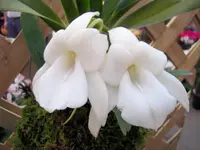
Angraecum magdalenae is a compact epiphytic orchid known for its thick, leathery leaves and large, waxy white flowers with a long nectar spur. It typically grows on rocks or trees in high-altitude forests of Madagascar, where nights are cool and air is fresh and humid.
This species is slow-growing and can be long-lived, so it suits patient growers who enjoy steady progress rather than rapid change. Flowers are strongly scented at night, which reflects its natural pollination by moths.
Because it dislikes root disturbance and needs a stable, airy environment, it is considered moderately challenging compared with common orchids. Learning how to care for Angraecum magdalenae usually involves providing bright, gentle light, good air movement, and evenly moist but fast-draining media.

Care Difficulty
Hard Care

Light Preference
Bright Indirect Light

Water Requirements
Regular Water

Temperature Preference
Tropical / Frost Sensitive

Hardiness Zone
Unknown

Soil Texture
Sandy, Rocky, Organic-rich

Soil pH
Acidic (5.5–6.5)

Soil Drainage
Well-drained

Fertilization
Light (every 4–6 weeks)
Scan your plant to receive care tips personalized for your specific plant
Available on iOS and Android
This orchid prefers bright, indirect light with some gentle direct sun at cooler times of day.
Watering should keep roots moist but never stagnant or waterlogged.
This species prefers cool- to intermediate-warm conditions with stable temperatures and good airflow.
This orchid prefers moderately high, stable humidity to support healthy roots and foliage.
This epiphytic orchid needs a very airy, fast-draining medium rather than dense mineral soil.
This species grows well in containers when given a stable, well-ventilated setup.
This orchid benefits from light, targeted feeding rather than heavy fertilization.
Pruning needs for Angraecum magdalenae are minimal and mainly hygienic.
This species prefers stable conditions and resents frequent disturbance of its roots.
Propagation of Angraecum magdalenae is specialized and usually left to experienced growers or labs.
This orchid is not frost hardy and needs careful indoor winter management in temperate climates.

Plant Health Check
Not sure what's wrong with your plant? Check your plant's health inside the app.
This species produces thick, white, star-shaped flowers that open mainly at night and release a strong, sweet fragrance, an adaptation linked to nocturnal moth pollination in its native habitats of Madagascar.
It often grows lithophytically, anchored on limestone outcrops and cliff faces where roots cling tightly to rock and access mineral-rich seepage rather than typical forest soil.
Its short, thick, leathery leaves act as water-storage organs, helping the plant cope with intermittent moisture and high light on exposed rocky slopes.

In its native range in Madagascar, this orchid is believed to be pollinated by long-tongued hawkmoths that can reach nectar hidden deep in the flower’s narrow spur, an example of coevolution between flower structure and pollinator anatomy.
Lack of flowers often comes from insufficient light, too-warm nights, or skipping a cooler, slightly drier winter rest. Moderate fertilizer and stable conditions help; avoid frequent repotting, which can delay blooming for a season or more.
Keep your plants happy and healthy with plant identification, disease detection, and easy care guidance.