


Substrate Preparation
Before planting, press a thin layer of milled sphagnum or finely sifted, weed-free woodland soil firmly onto rocks or wood to create a smooth, stable surface that allows rhizoids of the moss to anchor quickly.

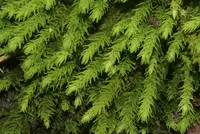
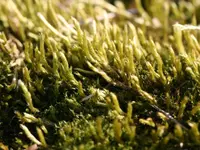
Anomodon viticulosus, often called anomodon moss, is a creeping, mat-forming moss that clings tightly to rocks, logs, and tree bases. It forms dense, green carpets with fine, branching stems that create a soft, textured surface.
This species occurs widely in temperate forests of North America, Europe, and parts of Asia, especially in shaded, humid habitats. Its ability to tolerate some dryness once established makes it relatively forgiving compared with many other mosses.
It prefers consistent moisture, shade to dappled light, and stable, non-compacted surfaces such as bark, stone, or coarse substrate. These traits make it appealing for those learning how to care for anomodon moss in terrariums, shaded gardens, or naturalistic displays.

Care Difficulty
Moderate Care

Light Preference
Partial Shade

Water Requirements
Keep Soil Moist

Temperature Preference
Cold Hardy

Hardiness Zone
3–8

Soil Texture
Loamy, Rocky, Organic-rich

Soil pH
Acidic (5.5–6.5), Slightly acidic (6.5–7.0)

Soil Drainage
Moist but well-drained

Fertilization
Minimal (feed rarely)
Scan your plant to receive care tips personalized for your specific plant
Available on iOS and Android
This moss prefers soft, indirect light similar to a shaded forest floor.
Moist, cool conditions suit this moss best, but constant saturation should be avoided.
This species is adapted to cool, temperate climates with marked seasonal change.
This moss grows best in consistently moist, high-humidity conditions.
This species prefers a moist, stable substrate that mimics shaded rock or forest-floor conditions.
This moss is suitable for shallow containers, trays, and terrariums.
This moss usually grows well on nutrient-poor substrates and needs little to no fertilizer in cultivation.
Anomodon viticulosus needs only light grooming to keep mats dense and healthy.
This species is more often transplanted as mats or patches than repotted as an individual plant.
New colonies of Anomodon viticulosus are typically started by vegetative division rather than from spores in home settings.
This moss is cold hardy in most temperate climates and usually needs no special winter care outdoors.

Plant Health Check
Not sure what's wrong with your plant? Check your plant's health inside the app.
This moss often anchors in tiny cracks of calcareous rocks and tree bases, slowly widening fissures as its rhizoids and accumulated organic matter contribute to micro-scale rock breakdown.
Its densely interwoven, creeping stems and short side branches form thick, velvety cushions that efficiently trap moisture and airborne particles, creating a stable microhabitat for small invertebrates and microbes.
The species shows a strong preference for mildly to strongly basic substrates such as limestone, mortar, and other calcium-rich surfaces, so its presence can indicate underlying calcareous geology or alkaline building materials.

In old masonry and historic stone structures, this moss is frequently one of the first bryophytes to colonize lime-rich mortar, where it can persist for decades and serve as a living record of stable, relatively undisturbed microclimatic conditions on the walls.
Growth is slow to moderate. In good moisture and shade, it usually extends 1–3 cm per year, forming thicker mats rather than gaining height. Stable humidity, gentle airflow, and minimal disturbance support growing anomodon moss more evenly.
Keep your plants happy and healthy with plant identification, disease detection, and easy care guidance.

orange wall lichen
Xanthoria parietina
Anaptychia runcinata
Anaptychia runcinata
antitrichia moss
Antitrichia curtipendula
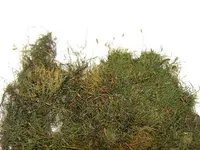
Creeping Feather Moss
Amblystegium serpens
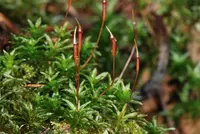
Selwyn's atrichum moss
Atrichum selwynii
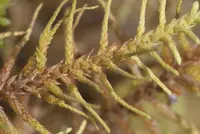
abietinella moss
Abietinella abietina
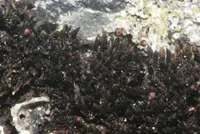
andreaea moss
Andreaea rupestris
brachythecium moss
Brachythecium salebrosum