Use airy mounts
Mount plants on cork bark or tree fern rather than in pots to keep roots well aerated and allow old, leafless rhizomes to be trimmed away cleanly after flowering.

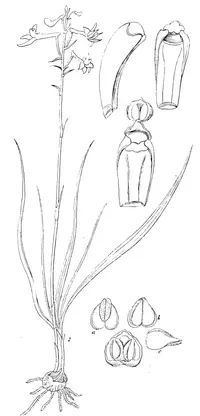
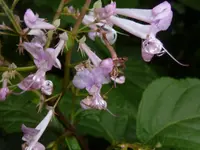
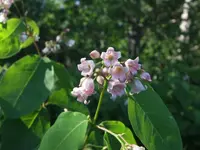
Anthogonium gracile is a small terrestrial orchid with slender grass-like leaves and delicate pink to lilac flowers held on thin, wiry stems. It forms loose clumps rather than dense mats. This species is native to parts of South and Southeast Asia, where it usually grows in open, seasonally moist grasslands and light woodland edges. Its natural habitat suggests a preference for bright light, good drainage, and moderate, not constant, moisture. The plant can be moderately challenging to cultivate, mainly due to its need for a marked seasonal rhythm and sensitive roots. Indoor growers who learn how to care for Anthogonium often focus on providing airy substrate, careful watering, and good air movement.

Care Difficulty
Hard Care

Light Preference
Partial Shade

Water Requirements
Keep Soil Moist

Temperature Preference
Tropical / Frost Sensitive

Hardiness Zone
Unknown

Soil Texture
Sandy, Loamy, Organic-rich

Soil pH
Acidic (5.5–6.5)

Soil Drainage
Moist but well-drained

Fertilization
Minimal (feed rarely)
Scan your plant to receive care tips personalized for your specific plant
Available on iOS and Android
This terrestrial orchid prefers bright, gentle light that mimics open woodland edges.
Watering should keep the root zone evenly moist but never saturated.
Stable, warm conditions support the healthiest growth and flowering for Anthogonium gracile.
This orchid prefers consistently moist air but adapts if extremes are avoided.
Provide a loose, airy medium that mimics an epiphytic orchid substrate.
This species is suitable for container growing when placed in a shallow pot or orchid basket.
This delicate terrestrial orchid benefits from only light feeding under cultivation.
Pruning needs for Anthogonium gracile are minimal and mainly hygienic.
This small orchid prefers stable conditions, so repotting or transplanting should be infrequent and gentle.
Propagation of Anthogonium gracile is possible but usually slow and suited to patient growers.
This species prefers mild, frost-free conditions, so some winter care is important in cooler climates.

Plant Health Check
Not sure what's wrong with your plant? Check your plant's health inside the app.
Anthogonium gracile is the only species in the genus Anthogonium, making it taxonomically distinct among Asian terrestrial orchids and of special interest to orchid systematists.
This species typically grows in open, seasonally wet grasslands and light scrub rather than in dense forest, an unusual habitat preference compared with many better-known tropical orchids.
The plant produces relatively large, pink to lilac flowers on slender stems that rise above very small, narrow leaves, creating a striking visual contrast in its natural habitat.

Anthogonium gracile has a broad but patchy distribution from the Indian subcontinent through Southeast Asia to southern China, and its scattered occurrences across this wide range make it a useful species for studying the biogeography and evolution of Asian terrestrial orchids.
Lack of flowering is usually linked to insufficient light, depleted nutrients, or the plant being immature. Ensure a pronounced dry rest after growth, avoid constant moisture, and provide a weak, balanced fertilizer only during active growth.
Keep your plants happy and healthy with plant identification, disease detection, and easy care guidance.