Red Pearls Anthurium Care (Anthurium gracile)

Red Pearls Anthurium

About Red Pearls Anthurium

Anthurium gracile is a compact epiphytic aroid, usually found hanging from trees in tropical forests of Central and South America. It forms trailing stems with narrow, elongated leaves and delicate upright flower spikes topped by a slender spadix.

In cultivation it is often grown in hanging pots or mounted on bark, where its fine foliage and airy inflorescences create a light, graceful look. Humid air, gentle filtered light, and a loose, airy substrate support healthy growth. These traits make it moderately easy to care for Anthurium gracile indoors if its moisture and humidity needs are respected.

Main Plant Requirements

Care Difficulty

Moderate Care

Light Preference

Bright Indirect Light

Water Requirements

Keep Soil Moist

Temperature Preference

Tropical / Frost Sensitive

Hardiness Zone

11–12

Soil Texture

Loamy, Peaty, Organic-rich

Soil pH

Acidic (5.5–6.5), Slightly acidic (6.5–7.0)

Soil Drainage

Moist but well-drained

Fertilization

Light (every 4–6 weeks)

Get Personalized Care Plan

Scan your plant to receive care tips personalized for your specific plant

Available on iOS and Android

How to Care for the Red Pearls Anthurium

This species prefers bright, filtered light that mimics a forest canopy.

  • Provide 6–8 hours of bright, indirect light each day, such as near an east window or under light shade outdoors, avoiding direct midday sun.
  • Tolerates partial shade, but in very low light new leaves become smaller, growth slows, and flowering may stop.
  • Protect Anthurium gracile from harsh afternoon sun, which causes leaf scorch; in winter, move slightly closer to the light source to compensate for shorter days.

This plant prefers evenly moist but never waterlogged root conditions.

  • Water when the top 2–3 cm of the mix feels dry, using slow, thorough watering until excess drains away, then empty any saucer or cachepot.
  • Use a loose, fast-draining aroid mix so roots receive both moisture and air; heavy, compact soil greatly increases the risk of rot.
  • Reduce frequency in cooler, darker months and watch for limp, dull leaves from underwatering versus yellowing, mushy stems from overwatering, especially around the crown.

Stable, warm temperatures support steady growth and root health.

  • Aim for 65–80°F (18–27°C) for active growth; short fluctuations are tolerated if changes are gradual rather than sudden.
  • Avoid letting temperatures drop below 55°F (13°C); cold drafts and sudden chills can cause yellowing or leaf drop, and frost is lethal.
  • In hotter periods above 86°F (30°C), increase air movement and humidity, shade from intense sun, and ensure the substrate does not dry out completely between checks.

This species benefits from consistently high humidity to support healthy foliage and root function.

  • Aim for 60–80% humidity; it tolerates brief drops but prolonged air below 40% leads to stress.
  • Crisp leaf edges, stalled growth, and brown root tips indicate air is too dry.
  • Use a room humidifier, pebble tray with water below the pot base, or group plants to raise local humidity.

This plant prefers a loose, airy, organic-rich mix that drains quickly yet holds some moisture.

  • Use a mix of roughly 40% fine bark, 30% peat or coco coir, 20% perlite, and 10% compost for structure and nutrients.
  • Ensure the substrate is chunky and well-aerated; roots should sit among particles, not in compacted, soggy material.
  • Target a slightly acidic pH around 5.5–6.5, avoiding strongly alkaline mixes based on heavy garden soil or lime-rich media.
  • If existing mix retains water for more than 3–4 days, increase bark and perlite content to improve drainage and oxygen availability.

This species is well suited to container growing, including as an epiphyte-style plant in loose substrate.

  • Choose a pot only 2–3 cm wider than the root mass to keep the mix from staying wet for too long.
  • Select a stable, heavier container if growth becomes trailing so the pot does not tip as stems elongate.
  • Use breathable materials like unglazed clay when the environment is humid, as this slightly increases evaporation and reduces waterlogging risk.

This epiphytic aroid benefits from light, consistent feeding rather than heavy applications when grown indoors.

  • Use a balanced liquid fertilizer (around 10-10-10 or 20-20-20) diluted to 1/4–1/2 strength for Anthurium gracile in active growth.
  • Apply every 4–6 weeks in spring and summer, on already moist substrate to reduce root burn risk.
  • Pause or reduce feeding to 1 light dose in late fall and winter when growth slows.
  • Organic options like very dilute compost tea or a gentle slow-release pellet can be used sparingly in a chunky, airy mix.

Pruning is mainly hygienic for this species and helps maintain a neat, manageable clump.

  • In late winter or early spring, remove yellow, brown, or damaged leaves at the base with clean, sharp scissors or snips.
  • Cut out crowded or crossing stems to slightly open the plant, improving airflow and reducing rot risk.
  • Trim spent inflorescences close to their base to direct energy into foliage and new blooms.
  • Disinfect tools before and after use with alcohol to limit disease spread.

Container-grown plants appreciate occasional repotting to refresh the airy mix and give roots space.

  • Check for roots circling the pot, pushing through drainage holes, or noticeably slower growth as signs Anthurium gracile needs a larger container.
  • Repot every 2–3 years in late spring, moving only 1 pot size up and using a chunky aroid mix with bark, perlite, and some sphagnum.
  • Loosen circling roots gently with fingers, removing dead or mushy sections while keeping as much healthy root as possible.
  • After repotting, water thoroughly, keep humidity high, and shade from strong sun for 7–10 days to reduce transplant stress.

This species is most reliably propagated by division of mature clumps rather than by seed at home.

  • Plan division in warm late spring or early summer when growth is active and recovery is fastest.
  • Remove the plant from its pot, then separate natural offsets, ensuring each division has several roots and at least 1 healthy stem.
  • Plant divisions into small pots with fresh, airy mix, keeping the root zone evenly moist but not waterlogged.
  • Maintain high humidity (60–80%), bright indirect light, and stable warmth around 70–80°F to encourage rapid establishment.

As a tropical plant, this species is not frost tolerant and needs warm, stable indoor conditions in winter.

  • Keep temperatures above 60°F; avoid cold drafts from windows or exterior doors around the plant.
  • Move outdoor containers indoors before night temperatures drop below 55°F, placing them in bright, indirect light.
  • Water less often but do not let the mix fully dry; maintain gentle humidity with trays or a humidifier.
  • Keep foliage away from heaters and vents, which cause leaf scorch and rapid drying.

Care Tips

Support epiphytic growth

Provide a slim moss pole or piece of bark for the roots to grip so the plant can climb and produce longer, healthier leaves instead of sprawling loosely from the pot.

Use airy top-dressing

Add a thin layer of fine orchid bark or sphagnum moss on the soil surface to keep aerial roots slightly humid while still allowing rapid gas exchange around the crown.

Rotate for even vining

Rotate the pot 90° every 2–3 weeks so stems and leaves develop evenly around the support rather than leaning heavily to one side.

Inspect petioles closely

Check the slender stems and leaf undersides every 1–2 weeks with a hand lens if possible, since thrips and spider mites often hide there and are easier to control when found early.

Refresh substrate periodically

Every 2–3 years, gently shake old mix from the roots and repot into fresh, chunky aroid substrate to prevent compaction and maintain the high oxygen levels needed for growing Anthurium gracile.

Common Pests and Diseases

Bacterial blight

This disease often appears after prolonged leaf wetness and high humidity, causing water-soaked spots that turn brown with yellow halos and can lead to leaf collapse.

Solution

Remove and discard affected leaves, avoid overhead watering, keep foliage dry, and improve air circulation; in severe cases, isolate the plant and use a copper-based bactericide labeled for aroids while adjusting watering as part of broader Anthurium gracile care instructions.

Bacterial leaf spot

This disease causes small, translucent, water-soaked specks on leaves that expand into irregular brown lesions, often starting along leaf margins or near mechanical injuries.

Solution

Prune out spotted leaves with sterilized tools, reduce misting directly on foliage, increase spacing and airflow, and sterilize pots and tools; avoid splashing water between plants to limit spread.

Aphids

These insects cluster on young leaves, petioles, and inflorescences, sucking sap and causing distortion, sticky honeydew, and sometimes sooty mold growth on Anthurium gracile’s thin foliage.

Solution

Rinse colonies off with a firm but gentle stream of water, then treat remaining insects with insecticidal soap or a neem oil spray, repeating every 5–7 days until no new aphids appear and monitoring new growth closely.

Mealybugs

This pest appears as white, cottony clumps in leaf axils, along petioles, and on roots in the potting mix, weakening the plant and slowing growth as it feeds on sap.

Solution

Spot-treat visible insects with cotton swabs dipped in isopropyl alcohol, then follow with thorough applications of insecticidal soap or neem oil on all leaf surfaces and stems, repeating treatments and checking the root zone and pot edges regularly.

Fusarium crown rot

This disease develops under consistently wet, poorly drained conditions, leading to yellowing, wilting, and browning at the base of stems, with discolored, mushy tissue near the crown.

Solution

Remove and discard affected plants or severely damaged sections, improve drainage, avoid waterlogged media, and use a fresh, well-aerated aroid mix; sanitize tools and pots, and consider a fungicide labeled for Fusarium if valuable stock must be protected.

Interesting Facts

Berry-like infructescences

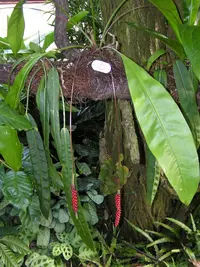
This species produces long, hanging infructescences covered in many small, bright red berries that are closely packed along the spike, giving it an ornamental, beaded-string appearance in fruit.

Epiphytic forest specialist

A. gracile naturally grows as an epiphyte on trees in humid lowland to mid-elevation tropical forests of Central and northern South America, using its roots to anchor to bark rather than to soil.

Simple, narrow foliage

Unlike many Anthurium species with large, lobed, or highly veined leaves, this species has relatively simple, narrow, strap-like leaves that emphasize the contrast with its showy fruiting spikes.

FAQs about Red Pearls Anthurium

This species is a slender, pendent epiphyte. Stems trail or hang rather than climb strongly or spread along the ground. It works well in hanging positions or on supports where the stems can drape naturally.

Grow Healthy Plants with Botan Care

Keep your plants happy and healthy with plant identification, disease detection, and easy care guidance.

Botan plant care app — identify plants on mobile

Explore More Plants