Early trellis training
Install a strong trellis, wire mesh, or fence before planting, then loosely tie young shoots with soft ties so the vine learns the structure and does not tangle or pull down weak supports later.

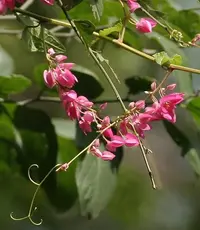
Coral vine, Antigonon leptopus, is a fast-growing, twining climber known for its long chains of pink or white flowers and lush, heart-shaped leaves. It is usually grown on fences, trellises, or arbors where it can form a dense flowering screen.
This species is native to Mexico and Central America but is now common in many warm climates, especially in frost-free regions. In suitable conditions it can spread quickly and may become invasive outdoors.
Coral vine prefers full sun, moderate moisture, and well-drained soil, which makes it relatively easy to establish. Gardeners who want to know how to care for coral vine should consider both its rapid growth and its potential to self-seed widely.

Care Difficulty
Easy Care

Light Preference
Full Sun

Water Requirements
Moderate Water

Temperature Preference
Tropical / Frost Sensitive

Hardiness Zone
9–11

Soil Texture
Sandy, Loamy, Organic-rich

Soil pH
Acidic (5.5–6.5), Slightly acidic (6.5–7.0)

Soil Drainage
Well-drained

Fertilization
Light (every 4–6 weeks)
Scan your plant to receive care tips personalized for your specific plant
Available on iOS and Android
This vigorous climber flowers best with strong, direct light in warm climates.
This drought-tolerant vine prefers deep, infrequent watering once established.
This warm-climate vine thrives in heat but is highly sensitive to frost.
This vine tolerates a wide humidity range and rarely needs special humidity management.
This species prefers light, fast-draining soil that does not stay wet after irrigation or rain.
This vine is suitable for container growing when the pot is prepared to support vigorous roots and climbing stems.
Antigonon leptopus responds well to moderate, balanced feeding during active growth.
Pruning Antigonon leptopus manages size, encourages flowering, and keeps the vine under control.
This vine is usually grown in the ground, so focus more on careful transplanting than frequent repotting.
Antigonon leptopus is commonly propagated by seeds and softwood cuttings under warm conditions.
Antigonon leptopus is frost-sensitive and needs protection in regions with freezing winters.

Plant Health Check
Not sure what's wrong with your plant? Check your plant's health inside the app.
In its native Mexico, this vine is an important nectar source for the stingless bee species Scaptotrigona mexicana, which visits the flowers intensively and can enhance fruit and seed production.
The roots form associations with nitrogen-fixing bacteria, which can increase available nitrogen in the surrounding soil and partly explains the vine’s vigorous growth in poor sites.
The seeds can remain viable in the soil for several years, creating a persistent seed bank that allows the plant to reappear even after aboveground vines are removed.

In several tropical and subtropical regions, this ornamental has become so invasive that it can completely blanket native vegetation and alter habitat structure, leading land managers to classify it as a high-priority target for biological and mechanical control programs.
Lack of flowers usually comes from too much shade, excess nitrogen fertilizer, or heavy pruning at the wrong time. Ensure strong sun, avoid high-nitrogen lawn runoff, and prune lightly right after flowering, not in early spring.
Keep your plants happy and healthy with plant identification, disease detection, and easy care guidance.