Anchor To Hardscape
Gently tie or pin the thallus to smooth rocks or driftwood with fine fishing line or plant weights for 2–4 weeks so it can firmly attach and form a stable, low mat.

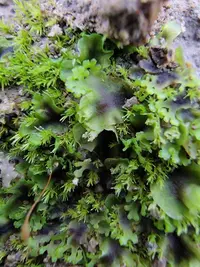
Endive pellia, Apopellia endiviifolia, is a small aquatic liverwort often used in aquariums and paludariums. It forms low, ruffled mats that attach to rocks, wood, or other hard surfaces.
In nature it grows in cool, clean, fast-flowing streams and on wet rocks in Europe and parts of Asia. Its compact size and slow, steady growth make it suitable for carefully arranged aquascapes.
This species prefers stable, cool conditions, gentle water movement, and consistently high moisture, which can make it a little demanding in warmer or unstable tanks. Understanding how to care for Endive Pellia helps keep its fronds dense, healthy, and firmly anchored.

Care Difficulty
Moderate Care

Light Preference
Partial Shade

Water Requirements
Keep Soil Moist

Temperature Preference
Warm Climate

Hardiness Zone
Unknown

Soil Texture
Loamy, Peaty, Organic-rich

Soil pH
Acidic (5.5–6.5)

Soil Drainage
Moist but well-drained

Fertilization
Minimal (feed rarely)
Scan your plant to receive care tips personalized for your specific plant
Available on iOS and Android
This liverwort prefers soft, filtered light rather than direct, intense sun.
Apopellia endiviifolia needs constant, even moisture and does not tolerate drying out.
Stable, mild temperatures support dense, healthy growth of this aquatic liverwort.
This liverwort prefers steady moisture in the air as well as at the substrate level.
This species grows best anchored to hardscape or in very fine, consistently moist, low-nutrient substrate.
This species is suitable for container culture in aquaria or paludariums where humidity and water movement are stable.
This small aquatic liverwort grows slowly and needs only light feeding under stable, clean-water conditions.
Pruning for Apopellia endiviifolia focuses on controlling spread and keeping mats healthy in the aquarium or terrarium.
This liverwort is usually attached to hardscape rather than potted, so care focuses on repositioning and reattaching rather than classic repotting.
Apopellia endiviifolia is commonly multiplied by dividing its cushions rather than from spores in home setups.
In heated indoor aquariums or terraria, this species needs no special winter care beyond stable conditions.

Plant Health Check
Not sure what's wrong with your plant? Check your plant's health inside the app.
This species is an aquatic liverwort that grows fully submerged, forming irregular, frilly mats attached to wood or rock by rhizoids, which are simple anchoring filaments rather than true roots.
It spreads mainly by fragmentation, where small broken pieces of the thallus drift away and reattach elsewhere, allowing rapid colonization of suitable aquarium or stream habitats without sexual reproduction.
In aquaria it is known to persist better in relatively cool, clean, well-oxygenated water and often declines in very warm, stagnant, or heavily polluted conditions, reflecting its natural occurrence in cooler streams and spring-fed waters.

This species was long cultivated and traded in the aquarium hobby under the incorrect name Pellia endiviifolia, and only relatively recently reassigned to the separate genus Apopellia following detailed morphological and molecular studies that clarified its true relationships among liverworts.
Growth is moderate under stable, high-humidity conditions. In a healthy aquascape or terrarium, new fronds typically appear within a few weeks, forming a noticeable mat over 2–3 months if lighting, water quality, and nutrients are adequate.
Keep your plants happy and healthy with plant identification, disease detection, and easy care guidance.